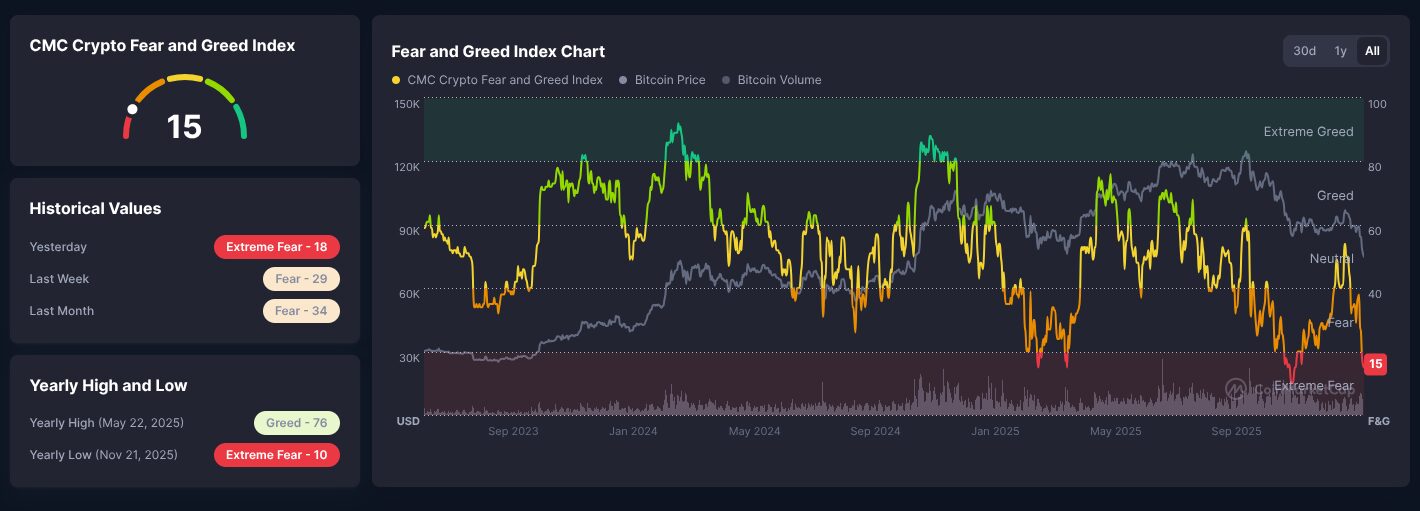
On the other hand, the market structure shows significant technical weakness. Bitcoin has broken multiple key support levels, including the 200-day moving average and the psychological level of $90,000, which has invalidated the bullish structure that had held since 2024.
On-chain data reveals that, for the first time since October 2023, Bitcoin holders are selling at a loss, a clear sign of capitulation among buyers who entered at six-figure levels. Volatility has been exacerbated by the liquidation of more than $1.3 billion in leveraged positions, an event that has reminded investors of the risks inherent in the capital structure of cryptoassets.
Widespread exhaustion
The situation has led to widespread exhaustion among investors, a situation that becomes evident when looking at the distance from the previous all-time high of $125,000. Analysis of the current consolidation structure suggests that the price is trapped in a range between $84,000 and $94,000, with persistent selling pressure seeking to fill the so-called "CME gaps", price zones not traded in futures markets that tend to act as magnets during corrections.
In addition, the lack of immediate catalysts and the "paralysis of the giants" among institutions have left the market in a state of lethargy, where volume shifts toward more traditional safe-haven assets.
Another of the catastrophic events for Bitcoin's reputation in January 2026 has been the discovery of a critical bug in versions 30.0 and 30.1 of Bitcoin Core, the reference software that underpins the network. On January 5, 2026, developers issued an urgent warning about a flaw in the wallet migration process that could cause the total and permanent deletion of wallet files, with the consequent loss of funds.
The risk of losing everything
The problem originates in the technical transition from the legacy Berkeley DB (BDB) database format to the new system based on SQLite descriptors. This structural change was designed to improve the security and functionality of wallets, allowing more efficient management of keys and scripts. However, the implementation of the "cleanup" logic in the event of a failed migration turned out to be fatally aggressive.
When the migration process fails due to specific conditions, such as having "pruning" enabled (chain pruning) or the presence of corrupt files that the software cannot read correctly, a cleanup code designed to delete the temporary files generated during the failed attempt is triggered. Due to a programming logic error, instead of deleting only the temporary files of the failed migration, the system executes an instruction that deletes the entire contents of the wallets directory.
Since Bitcoin Core supports running multiple wallets simultaneously, this bug destroys not only the default wallet.dat file, but any other wallet stored in the same folder, regardless of its size or importance.
Peg failures and forced liquidations on Paradex
But this technical crisis was not limited to the base layer. The Liquid network, a federated sidechain operated by a group of officials known as the Liquid Federation, also experienced significant failures this month. But Liquid was not the only one with problems; Starknet also had bad moments.
On January 19, 2026, what was supposed to be a routine maintenance update on Paradex, a derivatives platform on the infrastructure linked to Starknet's Bitcoin, turned into a financial disaster.
A scale-up error during the code deployment caused the funding rates of all markets to reset to zero. This distortion in profit and loss (PnL) calculations automatically triggered the liquidation engine, forcibly closing the positions of hundreds of traders who, under normal conditions, would have had sufficient margin.
To mitigate the disaster, Paradex made the controversial decision to perform a full "rollback" of its blockchain to a state prior to the maintenance. Although this measure allowed theoretical balances to be restored, it generated massive chaos by canceling open orders and leaving users in a state of total uncertainty. The platform paid out 650,000 from its "Liquidator Vault" to compensate some 200 affected users.
The quantum threat
To this must be added the statements of Chris Wood, chief equity strategist at Jefferies, who issued a warning that resonated across all institutional trading desks: the advance of Cryptographically Relevant Quantum Computers (CRQCs) represents an existential vulnerability for Bitcoin's security.
Although the risk has been discussed in academia for years, Wood's note in his Greed and Fear newsletter transformed the perception of the problem, turning it from a physics dilemma into an engineering challenge with potentially short timelines.
Bitcoin uses the Elliptic Curve Digital Signature Algorithm (ECDSA) to protect ownership of funds. In a classical computing environment, deriving a private key from a public one is an impossible task that would require trillions of years. However, a quantum computer with sufficient logical qubit processing capacity could perform this operation in a matter of hours or days.
The risk is immediate for wallets whose public keys are already visible on the blockchain. It is estimated that between 25% and 30% of the total Bitcoin supply, approximately 4 million coins, is stored in this type of address. This includes the famous Satoshi Nakamoto coins and old wallets that have not migrated to more modern, resistant formats such as SegWit. Wood argued that, if ownership can no longer be guaranteed with absolute certainty, Bitcoin loses its status as "digital gold", which prompted his decision to remove Bitcoin from his model investment portfolio in favor of physical gold.
Massive ETF outflows and the macroeconomic factor
On the other hand, Wall Street's confidence in Bitcoin has shown deep cracks. Spot Bitcoin exchange-traded funds in the United States recorded some of their worst figures since launch, with daily net outflows exceeding $817 million on Thursday, January 29.
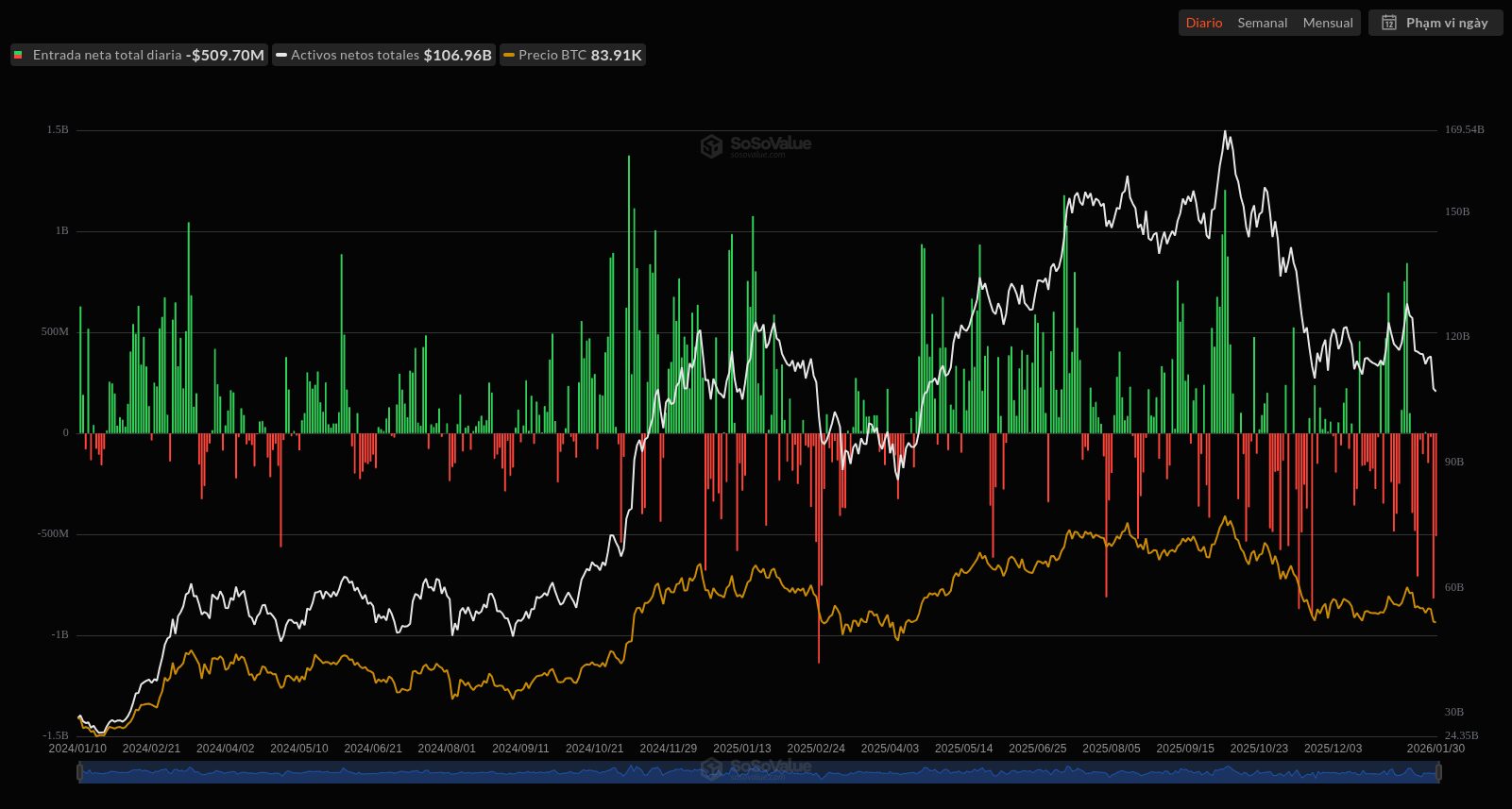
A fundamental driver of this exodus has been the nomination of Kevin Warsh as Federal Reserve chairman. Warsh is perceived by markets as a liquidity hawk, which has led investors to readjust their expectations about the path of interest rates.
This shift has particularly affected the "basis trade", a strategy used by leveraged institutional capital that flows through ETFs. As liquidity conditions tighten and bond yields rise, Bitcoin's appeal as a risk asset declines sharply.
This segment of capital is exceptionally sensitive to changes in global liquidity. According to analysts at HashKey Group, Bitcoin ETFs function as a critical channel for leveraged capital; when investors lower their risk profiles amid political uncertainty, they rotate out of high-volatility assets and take refuge in traditional assets such as gold.
But while Bitcoin struggled with software bugs and quantum distrust, global capital has sought refuge in tangible assets. January 2026 has been the month of absolute dominance for precious metals, which have reached historic milestones driven by geopolitical uncertainty and short-term dollar weakness.
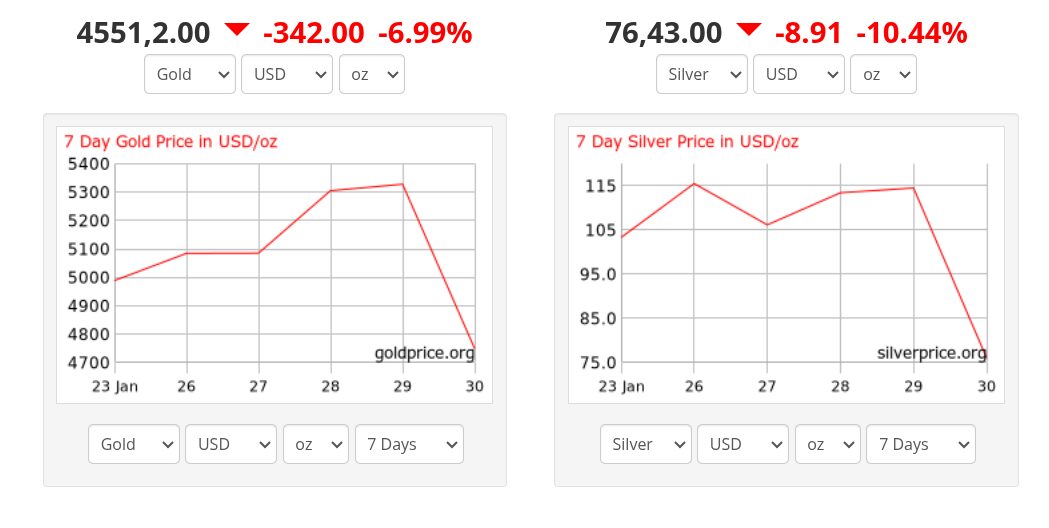
The price of gold reached an all-time record of $5,080 per ounce on January 26, 2026, marking an increase of 17% in the first month of the year alone. This move has been driven by trade tensions stemming from the Trump administration's tariff threats against Canada and the European Union, as well as instability in the South China Sea. Investors have abandoned the "digital gold" narrative in favor of physical gold, which has gained 83% in year-on-year terms, massively outperforming Bitcoin, which has lost 17% over the same period.
Silver breaks the $100 barrier
For its part, silver has shown even more explosive behavior, surpassing $100 per ounce for the first time in history and reaching peaks of $120 during the most volatile sessions.
With a cumulative gain of almost 48% so far in 2026, the white metal has benefited both from its role as a monetary safe haven and from growing industrial demand. The use of silver in solar panels and AI data center projects has reduced global inventories, creating a supply shock that has pushed prices to levels never seen before.
Bleak prospects
Given all this, the outlook for the rest of 2026 is, at best, uncertain. The confluence of negative factors has led many financial institutions to sharply cut their price forecasts. Standard Chartered, which previously projected Bitcoin at $300,000, has revised its target down to $150,000, citing that the leveraged expansion phase by Digital Asset Treasuries (DATs) has come to an end.
And this brings us to one of Bitcoin investors' most feared scenarios, "a sleepy year". This scenario proposed by analysts at Fidelity and Fundstrat, is based on the lack of new narratives and the tightening of global liquidity, which would keep Bitcoin in the $50,000 to $60,000 range throughout 2026.
Given this, Bitcoin's recovery will depend not only on an improvement in macroeconomic conditions and a possible pivot by the Federal Reserve in the second half of 2026, but on a forceful technical response that restores confidence in the security of its base code and in its resilience to relentless technological progress.