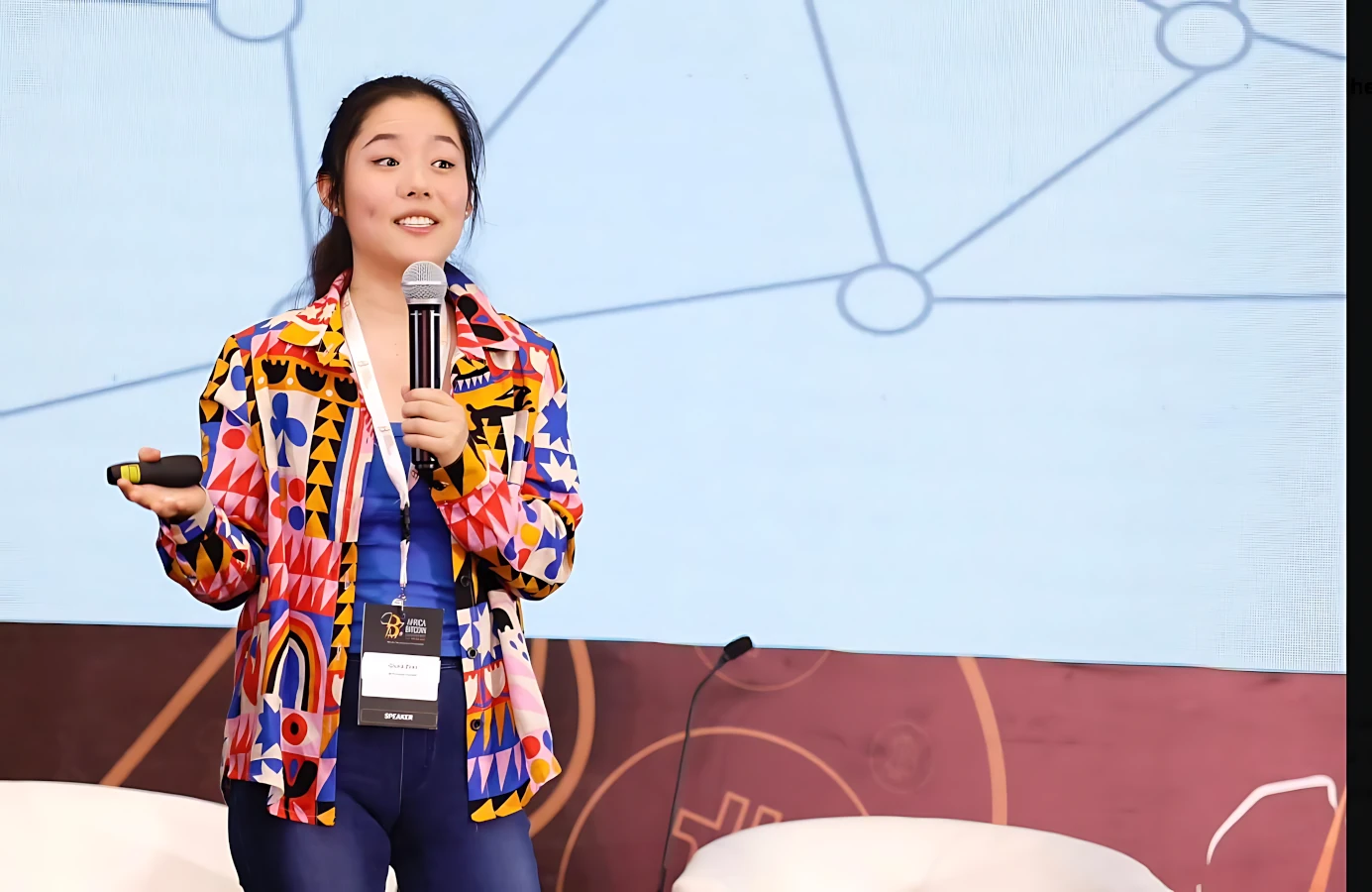
However, the disproportionate scrutiny and personal attacks she faced over the past year, particularly linked to her management of non-financial data limits, have raised urgent questions about the sustainability of open source development in a system that lacks formal governance structures to protect its volunteers.
Gloria Zhao's technical profile
Gloria Zhao's career in Bitcoin protocol development began in 2019, and she quickly stood out for her analytical capacity in low-visibility but highly critical areas for the network. Zhao was the first woman maintainer of Bitcoin.
In 2021, she became the first fellow of Brink, an organization focused on funding digital asset protocol development, backed by entities such as the Human Rights Foundation 's Bitcoin Development Fund and Spiral, founded by Jack Dorsey. Her appointment as maintainer in July 2022 made her the first known woman to hold this role of "gatekeeper" of the code, responsible for reviewing, approving and signing the changes proposed by the global developer community.
HISTORIC BLOW FOR STRATEGY: $12.4 BILLION IN BITCOIN LOSSES
Her technical work focused on what is known as mempool policy and peer-to-peer (P2P) relay, elements that dictate how nodes select and propagate transactions before they are mined.
Zhao was the lead architect of improvements aimed at reducing transaction censorship and strengthening the system's resilience against denial-of-service (DoS) attacks. In addition to her code output, she carried out vital educational work through the Bitcoin Core PR Review Club, where she mentored new contributors to ease their integration into the project's demanding review culture.
The impact of BIP 331: improving transactions on Bitcoin
One of Zhao's most sophisticated contributions was the design of BIP 331, known as Package Relay. Historically, Bitcoin nodes evaluate transactions individually to decide whether to accept them into their mempool.
However, this approach has flaws when a low-fee transaction has a "child" with a very high fee (the Child Pays For Parent or CPFPmechanism). If the parent transaction does not meet the node's minimum fee requirements, both are rejected, preventing the child's economic incentive from rescuing the parent.
The Package Relay proposed by Zhao allows transactions to be sent and evaluated as a set or "package", allowing the combined fee rate to be the acceptance criterion.
THE DOLLAR FALLS, BITCOIN WAITS AND BINANCE DECIDES THE COURSE OF THE CRYPTO MARKET
This improvement is fundamental to the reliability of Lightning Network and other second-layer digital asset protocols, where the ability to confirm closing transactions during periods of high congestion is a critical security requirement. By enabling package relay, Zhao eliminated "pinning" attack vectors, where a malicious actor attempts to block the confirmation of legitimate transactions by manipulating mempool priority rules.
Package Relay protocol specifications
The protocol designed by Zhao includes granular negotiation between peers during the initial connection handshake through a message called sendpackages.
Nodes can agree to exchange information about ancestors and descendants efficiently, avoiding wasted bandwidth on transactions that are likely to be rejected by their peers.
This architecture was designed to be extensible, allowing future versions of the protocol to support more complex package types without requiring disruptive changes to network consensus.
Safeguarding the security of Layer 2s
Complementing her work on package relay, Zhao led the implementation of BIP 431, also known as Topologically Restricted Until Confirmation (TRUC) or Version 3 transactions.
This standard introduces a series of restrictions on the topology of unconfirmed transactions to simplify the analysis of node incentives and improve the reliability of the Replace-By-Fee (RBF). Transactions that signal themselves as TRUC accept strict limits on their number of ancestors and descendants in the mempool.
These mathematical restrictions are essential to combat "pinning" attacks in multisignature environments, such as digital asset payment channels. By limiting the complexity of unconfirmed transaction chains, TRUC ensures that a user can always "bid" with a higher fee so that their transaction is processed.
This prevents an attacker from blocking this process by attaching a massive chain of low-fee transactions that the node would refuse to evict due to computational limits.
THIS IS HOW BITCOIN AND ETHEREUM ARE PREPARING FOR THE QUANTUM THREAT
The OP_RETURN war
But Gloria Zhao's resignation cannot be dissociated from the intense technical dispute that arose in 2025, after the release of Bitcoin Core v30. This version introduced a more permissive mempool policy regarding the use of the OP_RETURN opcode, a function that allows arbitrary data to be embedded in the blockchain.
Historically, Bitcoin Core limited these outputs to a maximum of 84 bytes and a single instance per transaction to disincentivize use of the network as non-financial data storage. However, with the proliferation of protocols such as Ordinals and Inscriptions, users found ways to embed megabytes of data using the "witness" fields of SegWit and Taproot, often with fee discounts. Faced with this reality, Core developers, including Zhao, chose to relax the OP_RETURN limits in v30 to 100 KB and allow multiple outputs per transaction.
A better option
The technical argument was pragmatic honesty: if users are going to embed data anyway, it is preferable that they do so through visible mechanisms that are easy for nodes to filter, rather than using "tricks" that complicate validation. This decision was met with extreme hostility by a faction of the community, led by figures such as Luke Dashjr, who described the change as an "attack on Bitcoin" and a transformation of a financial system into a "data dump".
Critics argue that allowing mass storage of non-monetary data increases hardware requirements for node operators, threatening decentralization in the long term. In this climate of polarization, Zhao, as the maintainer responsible for mempool policies, became the main target of attacks, which led to harassment campaigns that went beyond the technical into the personal.
Toxicity and harassment in Bitcoin
Hence Zhao's exit has been described by close observers as a "rage quit", or resignation due to exhaustion after months of relentless hostility. In 2025, the developer had already removed her presence from social platforms after a livestream by BitcoinMechanic, in which he publicly questioned her credentials and professional ability.
Curiously, BitcoinMechanic is a pro-Luke Dashjr "influencer" (he works with him at Ocean) rather than a developer, and comparatively his development contributions are much smaller (743 contributions from BitcoinMechanic, versus 4,536 from Zhao). And alongside BitcoinMechanic, another repeat attacker is Jacob King, who has even said on his X account that Gloria Zhao worked closely with a developer linked to Epstein.
FAITH IN BITCOIN GROWS THANKS TO ITS MATHEMATICAL DISCIPLINE, VERSUS KITSCH ABUNDANCE
Nothing new in the community
But this type of incident is not isolated in the history of Bitcoin development, a project that, despite its trillion-dollar market value, still depends on the voluntary work of a handful of individuals whose best intentions are their motivator.
The harassment reported by Zhao's supporters, such as Chris Seedor of the digital asset security firm Seedor, underscores a systemic governance problem. Seedor argued that "this does not make Bitcoin safer; it makes it poorer, thinner and less secure, because it teaches those who maintain the protocol that sustained harassment is the price of competition."
This pattern of attrition of human capital suggests that Bitcoin's decentralization, while its greatest technical strength, is also an operational weakness in terms of talent management. Lacking a hierarchy, technical disagreements are often resolved through social attrition, which drives out the most collaborative individuals and retains the most dogmatic, a process that could lead to negative ossification of the code.
And the result, like Zhao's departure, is not new. Bitcoin's toxic environment, especially from its community, has already taken a toll on several developers. Figures such as Ava Chow, Mike Hearn, Martti Malmi, Jeff Garzik, Wladimir van der Laan and Matt Corallo. All of them have in common a partial or complete withdrawal from Bitcoin development due to the toxicity of the environment.
Between authority and service
Faced with this situation, it is essential to understand that Bitcoin Core maintainers are not "owners" of the protocol, but rather stewards of the integrity of the code repository. Their main role is to ensure that proposed changes have gone through a rigorous peer review process and that they do not introduce critical vulnerabilities or unwanted changes to the consensus rules. Zhao, in her role as maintainer, had the technical ability to decide which code was integrated into the official version, but always under the scrutiny of a community of hundreds of other developers.
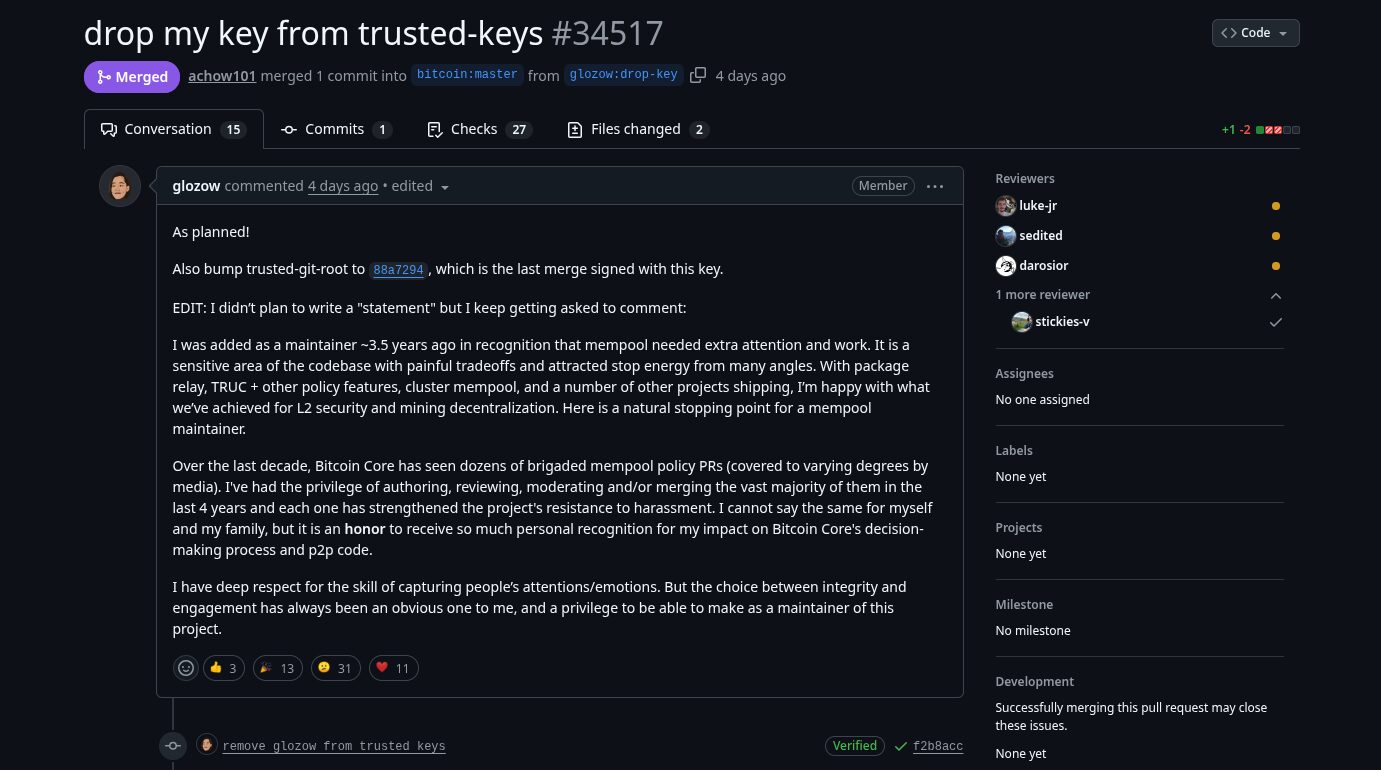
Zhao's resignation reduces the number of people with write access to the main Bitcoin Core repository to just five individuals. This concentration of maintenance capacity is a risk for the network, not because the remaining maintainers are malicious, but because it increases what is known as the "bus factor": the minimum number of people who, if they disappeared, would halt the project's progress.
Thus, Zhao's exit, a specialist in one of the most complex areas of the code, weakens the team's ability to respond quickly to errors in relay policy or vulnerabilities in the mempool.