What is BIP-110 and why did it fracture the community?
BIP-110, introduced by pseudonymous developer Dathon Ohm with the original draft and technical advice from Dashjr, proposed imposing for roughly a year a series of consensus limits on the amount of non-financial data that can be embedded in transactions: capping new scriptPubKeys at 34 bytes, restoring an 83-byte limit for OP_RETURN outputs, restricting various data pushes and Taproot witness elements to 256 bytes, and blocking Taproot features used by inscriptions (the technique behind Ordinals).
The trigger was Bitcoin Core version 30, released in 2025, which removed the historical OP_RETURN relay limit at the policy level. For RDTS supporters, that turned Bitcoin into a data dump; for its critics, the proposal was a restriction disguised as an anti-spam measure that set a dangerous precedent: invalidating currently valid transactions that pay fees.
A controversial idea
The activation method was the most controversial point. BIP-110 required miner signaling of only 55%, compared with the historical 95% for soft forks such as SegWit, but with a “mandatory signaling” design: nodes running Bitcoin Knots with the RDTS rule enabled would begin rejecting blocks that did not signal the change, a user-activated soft fork (UASF) mechanism.
The BIP number was assigned on December 3, 2025, directly by Luke Dashjr without any discussion (a violation of the BIP development protocol), and the proposal reached “Complete” status in the repository on June 25, 2026, despite Murch himself, editor and author of the new BIP-3 process (which is the model currently followed), publicly describing it as “a poorly targeted and exceptionally careless soft fork proposal.”
Bitcoin motion of no confidence: Luke Dashjr removed as BIP editor
The weekend Bitcoin split in two
Mandatory signaling began at block 961,632, which arrived on the evening of Saturday, August 8, 2026. Miner support never exceeded 2.6%, far from the required 55%. When the AntPool pool produced block 961,632 without signaling, BIP-110 nodes rejected it and followed an alternative branch. The pseudonymous mining group Roughnecks, operating through the OCEAN pool, mined the only two blocks on that chain (961,632 and 961,633) before everything stopped. After all, continuing to mine a chain like BIP-110 would cost them about 300,000 dollars a day, which is unviable.
The result was a ghost chain: on the morning of Monday, August 10, the minority branch was still frozen at block 961,633 while Bitcoin had advanced more than 200 blocks (240 according to some monitors). The branch inherited the full difficulty of the main network, about 127.48 trillion, with a fraction of its hashrate. Michael Saylor, executive chairman of Strategy and the proposal's loudest critic, calculated that at that rate the chain would need about 25 years to complete its first difficulty adjustment: “Consensus is earned, not declared”, he wrote, noting that about 99.85% of hash power remained with Bitcoin.
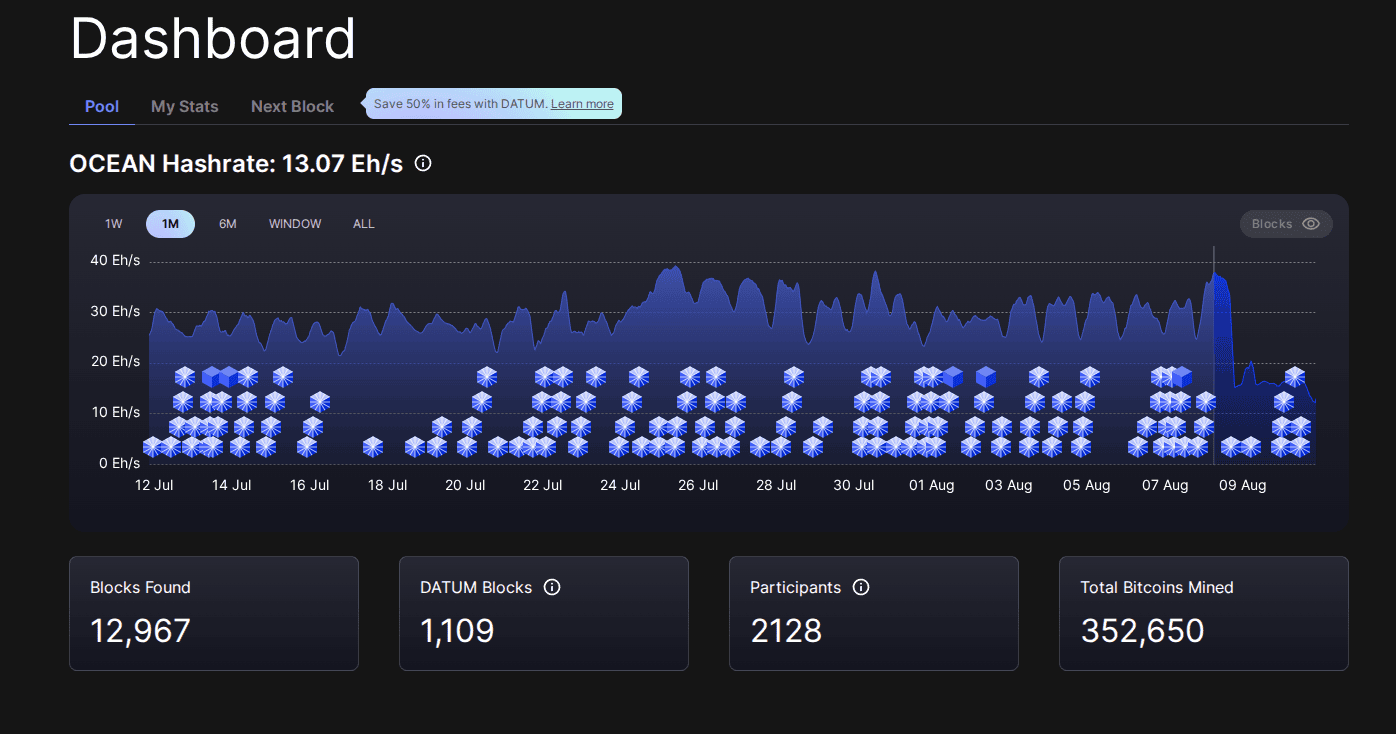
The collapse dragged down OCEAN, the pool co-founded by Dashjr. Its hashrate fell from about 36 exahashes per second (EH/s) on August 8 to about 12.5 EH/s the next day, and the pool admitted on Monday that a “configuration failure in its Stratum templates” redirected some miners to the BIP-110 chain for about 18 hours without clear consent. OCEAN promised to compensate with about 0.3 BTC in refunds, but because of this, the mining community was already demanding leadership changes at the pool.
Luke Dashjr and Mechanical leave OCEAN
In fact, that demand may already be a reality. Luke Dashjr has announced on his X account that he has stepped down from his position as Chairman and CTO of OCEAN, citing that he will now «devote himself to making a new Bitcoin a reality». For his part, Mechanical has commented that he will accompany Luke on that journey. Recalling that Mechanical was OCEAN's CBO.
This break by Dashjr and Mechanical is related to the manipulation of OCEAN's mining templates. OCEAN made a group of its miners believe they were mining for the Bitcoin network, when in fact they were mining for the BIP-110 network, and the two people with direct access and an interest in this are precisely: Dashjr and Mechanical.
And although OCEAN has taken the decision to make amends with 0.3 BTC in compensation, the loss of trust and the manipulation are done.
The “plan B”: a new PoW to “fire the miners”
However, far from interpreting the result as a defeat, BIP-110's promoters framed it as an attack. “It appears the large mining pools have colluded to turn Bitcoin from money into a toxic data dump by running a secret hard fork against the node network,” Dathon Ohm wrote on August 9, announcing that the community was working on “a proof-of-work change proposal to fire the miners.” Asked how the network would remain secure without the current miners, Ohm answered bluntly: “We'll hire new miners.”
Dashjr, maintainer of Bitcoin Knots and co-founder of OCEAN, backed that direction: “There are only a handful of bad actors attacking it. The PoW change removes their threat.” When asked what he considered flawed about SHA-256d, he cited ASICBoost, a technique that allows some miners to hash more efficiently by exploiting a quirk in the block header and that, according to its critics, gives large pools an asymmetric advantage.
In the Bitcoin Knots Discord, where the discussion focused on candidates such as RandomX, KT256, BLAKE3, Scrypt and Autolykos v2, one participant summed up the motivation bluntly: “The reason to abandon SHA256d is to fire the miners, not because it's broken.” Dashjr replied: “It's broken too.”
Saylor sells bitcoin for a second consecutive week: 3,328 BTC in 14 days
An old plan
The plan did not come out of nowhere. Developer Chris Guida confirmed on August 4 that he had rebased onto Bitcoin Knots the hard fork code for changing PoW that Dashjr himself wrote in 2017, during the block size wars. “It's just code to have in your pocket in case the miners betray Bitcoin, to activate at some later point,” Guida explained.
The tentative date, proposed by Dashjr, is September 1, 2026: the day BIP-110 was supposed to have activated its rules. Roughnecks, for its part, announced on Monday that it would resume mining from block 961,633 to keep the branch alive until a “sensible PoW change” arrives.
The economic consequences of such a change would be brutal. Every existing ASIC would become obsolete on the new chain, and supporters would have to build a mining industry, an exchange list and a user base from scratch. In practice, a PoW change would turn a branch of a failed soft fork into an independent altcoin. No major exchange has announced support for the minority chain. And without backing, it would be an altcoin stillborn.
Luke Dashjr's expulsion as BIP Editor
But the chain's collapse opened a second front, this time institutional. On Sunday, August 9, editor Mark “Murch” Erhardt submitted a formal motion to the Bitcoin development mailing list to expel Dashjr from the BIP Editors team, and made it concrete in pull request 2248 of the bitcoin/bips repository.
The grounds, detailed by Murch, were four: first, a conflict of interest in handling BIP-110, including the attempt to assign a BIP number publicly on X before the proposal was discussed on the mailing list, and the merging “within minutes” of a pull request updating the proposal.
Second, a minimal contribution to editorial work (less than 1% of editors' comments since April 2024, with that merge being his first action since May of that year); third, that his advocacy of a controversial soft fork that “now appears to be evolving into a hard fork” represents “a complete abandonment of the Bitcoin development ecosystem”; and fourth, the breakdown of trust and communication with his co-editors.
The motion received support from development heavyweights: Matt Corallo backed it unreservedly, Olaoluwa Osuntokun formally seconded it, Jonas Nick supported it citing that Dashjr had claimed that “BIP110 is Bitcoin,” that “BIP110 has consensus” and that “activation is safe,” in addition to repeatedly describing the proposal as “zero risk.”
Unanimous support
Anthony Towns was scathing: “This is overdue,” noting that the expulsion should have happened long ago. Jameson Lopp pointed to the absence of a formal removal mechanism: “there is no governance structure for BIP Editor management,” but concluded that the matter was reputational. Antoine Riard asked Dashjr to step aside.
Although he warned that BIP-1, BIP-2 and BIP-3 do not provide for a removal process and called for a fair procedure, also mentioning the 2022 episode in which Dashjr turned to the FBI over the loss of his coins and revealed the names of all participants in the CoreDev Atlanta meeting.
Dashjr rejected the accusations as “false,” maintained that he had followed the BIP process for years, called the mailing list “completely captured and corrupt” and filed a counter-motion to remove Murch. It was to no avail. This Monday, August 10, editor Bryan Bishop announced on the mailing list that Dashjr “is no longer a user with permissions on the BIP content repository”, and pull request 2248 was merged by Jon Atack at around 17:30 UTC, updating BIP-3 to remove his name from the editors list.
With this, Luke Dashjr is formally expelled from Core Dev and no longer has access permissions to the repository. His story ends just like that of Gavin Andressen, who at the time found himself in a similar situation, ended up losing all his access to the repository and was expelled from Core Dev.
Grayscale abandons its Polkadot ETF with DOT sunk at 0.80 dollars
A decade-long record and a door that closes
Dashjr was a BIP editor practically since 2011 and for more than a decade was the sole person responsible for assigning numbers and merging proposals, a de facto monopoly that sparked recurring frustration.
But in April 2024, after months of debate, five editors were added (Bryan Bishop, Murch, Ruben Somsen, Olaoluwa Osuntokun and Jonatack), a reform explicitly designed to end his exclusive control. That was in addition to responding to a reality that Dashjr and his retinue seem unwilling to accept: Dashjr has gone more than 28 months without performing tasks within the BIP ecosystem, and his only recent actions were to favor BIP-110.
Along the way there were episodes such as the blocking of Taproot's activation parameters in 2021 (Dashjr was openly opposed), the attempt to pass his Bitcoin Knots fork off as Bitcoin Core in the Gentoo package in 2014, and the dispute over the use of Core's translation resources for Knots in 2024.
There is a structural irony in the motion: Dashjr wrote BIP-2, the process document that governed BIP editing for nine years, while Murch wrote its replacement, BIP-3, which “explicitly narrowed the margins of discretion assigned to the editor role.” For Dashjr's defenders, the sequence is a purge: they rewrote the process to limit his discretion and then removed him for exercising it.
For his critics, it is the closing of a cycle in which Dashjr placed himself outside the norms: first by rushing a contentious soft fork and then by leading the movement toward a hard fork that most of the ecosystem considers hostile. Murch summed it up by quoting Dashjr's own words: “Now that you've been made king of your own forkcoin… ‘Bpedo is not Bitcoin’.”
Implications and outlook
Now that the BIP-110 proposal is closed, the scenario comes down to two paths. If the PoW plan is executed on September 1, an independent chain will be born with a new algorithm, with no exchange listings, no compatible ASICs and without the economic alignment that BIP-110 never achieved through the soft fork route; its promoters would have to “hire” a mining industry from scratch, a multi-stakeholder coordination problem exactly like the one that already failed on the soft branch. If it is not executed, the threat remains as what many in the ecosystem believe it was: a bluff by a minority that tried to impose rules by node decree and lost.
The episode, in any case, has already changed Bitcoin's governance permanently. The first removal of a BIP Editor in history leaves the community without a procedural precedent, forces a discussion of whether the role should be a simple notary or a gatekeeper with judgment, and shows that, even without a formal removal mechanism, reputation and rough consensus remain the ultimate law of Bitcoin development. What BIP-110 failed to achieve in consensus, the expulsion of its main promoter achieved in practice: closing the circle on a decade of conflicts around Luke Dashjr.