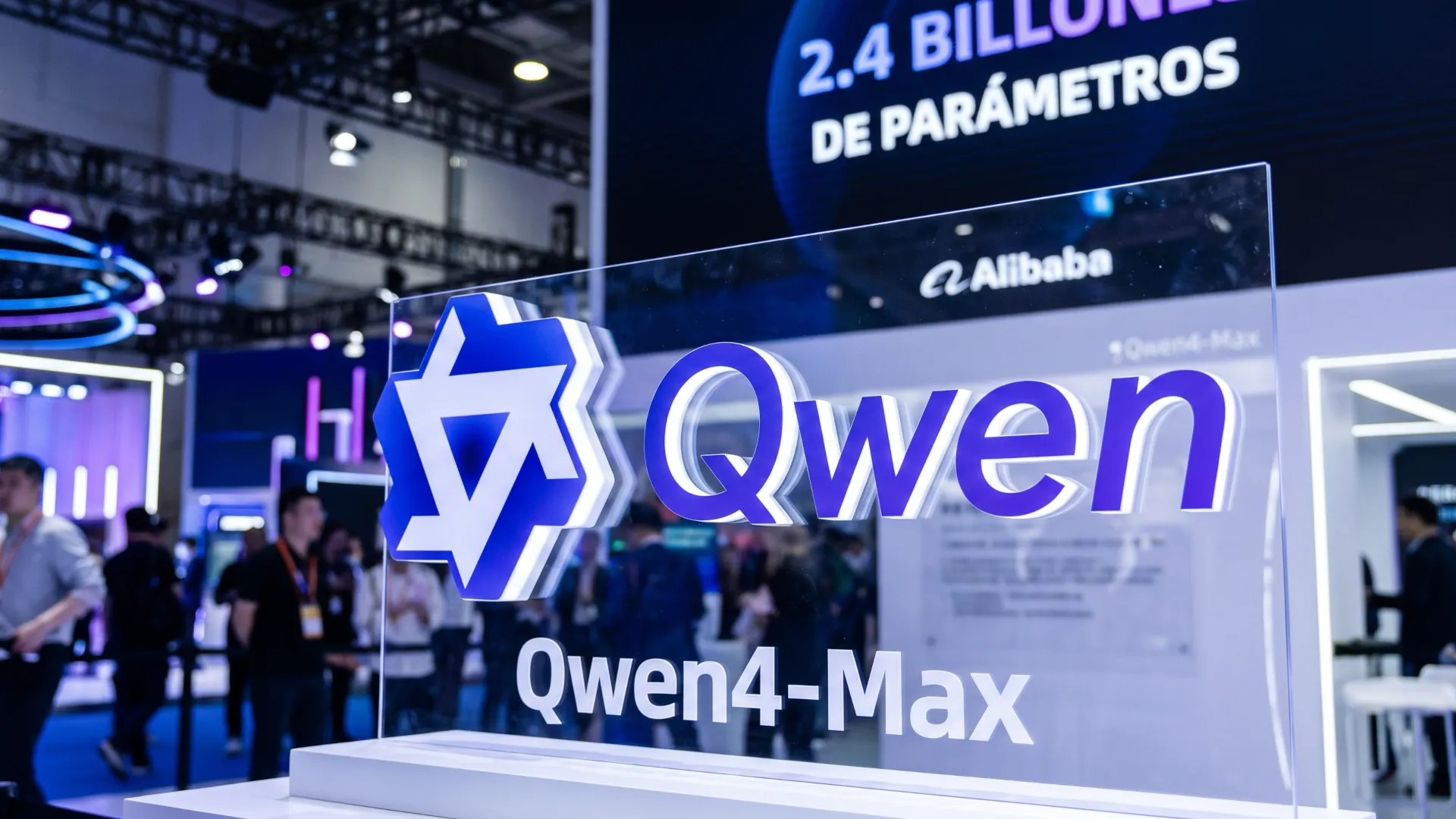
Alibaba unveiled its Qwen4-Max model on November 16, 2026, a closed piece with 2.4 trillion parameters with which the Chinese company aims to compete in the high-end segment without giving up the safety narrative. The announcement came with two arguments that rarely appear together: a much lower price per task than its predecessor and a deliberate filtering of the training so that the model does not know how to attack systems.
The size figure places it close to Kimi K3, the 2.8 trillion model that until now set the Chinese benchmark and that serves as a comparison for any launch from the country. The difference in scale does not explain performance, and Alibaba does not use it as its main argument. Its pitch rests on cost and on safeguards, the two variables that decide adoption in enterprises.
In the preliminary evaluation by Arena.ai, Qwen4-Max appears as the first Chinese model in the overall ranking and fifth in the world, behind the offerings from Anthropic, Google, OpenAI and Meta. That position describes a gap that is narrowing but not closing, and helps explain why Alibaba competes on price rather than on first place.
An extremely powerful and versatile model
The weights are not available, so no one can run Qwen4-Max on their own machine or fine-tune it with their own data. The backbone has 2.4 trillion parameters, a figure that measures the size of the model and not its quality, because training and data matter as much as scale. The company has not published the full architecture or the number of tokens used.
The capabilities it announces are those of a generalist model with a professional orientation, and the list ranges from three-dimensional modeling to scientific discovery, including video game development and healthcare. Each of those areas demands different tools and data, and a model that claims to cover them all usually performs unevenly in practice.
Price is the most concrete argument and the only one that can be compared without arguing over methodologies, although the exact figure depends on the outlet: InfoWorld speaks of 62 percent and Alibaba went as far as presenting the cut as 60 percent. Artificial Analysis puts the cost per task of its intelligence index at 3.27 dollars, 67 percent less than the 10.02 dollars of Qwen3.8-Max. The drop combines a rate reduction with lower token consumption to solve the same task, and that second part is what really changes the economics of a product.
Alibaba does not detail how many of those tokens are spent on internal reasoning, a figure that matters to anyone billing by usage. A model that thinks more can be cheaper per task and more expensive per minute of waiting, and the decision depends on what is measured.
The cybersecurity filter
The part of the announcement that will draw the most attention is the filtered training. Alibaba claims it removed offensive cyberattack capabilities from the training data and kept defensive ones, such as detecting and fixing vulnerabilities. The company maintains that an internal review concluded that defensive capability improved substantially.
That kind of filtering is not new. Labs have long been applying rejection and data curation techniques to prevent a model from writing exploits or malware. What changes here is the framing: instead of talking about alignment, Alibaba is selling a competitive advantage, because a model that cannot attack is easier to approve in a security department.
The problem with these filters is that the capability is not eliminated, it is restricted. A model with knowledge of networks can reason about a vulnerability even when asked to do so from the defensive side, and the line between explaining a flaw and exploiting it is thin. The public tests carried out to measure that boundary usually fall short.
The other doubt is verifiability. With no published weights, no one outside Alibaba can check what was removed from the training or how the defensive improvement was measured. The user is buying a statement, and in cybersecurity a statement without an independent audit is worth as much as the manufacturer's reputation.
The comparison between models has become a conversation about invoices, and that changes the criteria with which a tool is chosen on a team that cannot afford a three-month trial.
What does it mean for the model market?
Competition has shifted from size to cost per task, and that change favors providers that control their own infrastructure. First-tier models cost between ten and twenty times more than their alternatives, and that difference is not justified in most enterprise use cases, where the quality required is good rather than maximum. A model that solves 90 percent of tasks at a third of the price wins more contracts than the one that solves 95 percent at full price.
That move was already seen with Meta's cheap model for running agents a few days ago, and with the family of open models that run locally and compete on cost with commercial interfaces. The difference with Qwen4-Max is that it arrives with the brand of a cloud giant, and that brand opens doors at companies that do not buy models from an unknown lab.
For teams building agents, price per task is the variable that decides the architecture. An agent that queries ten tools and reasons three times consumes far more than a simple answer, and the cost multiplies with each step. A model that is 67 percent cheaper allows more ambitious agents to be designed without the bill spiraling out of control.
The trade-off is dependency. Choosing a closed model from a foreign provider ties the product to its prices and its policies, and changes to terms arrive without notice. Companies that build on a single interface know this and live with it.
What the announcement does not say
Alibaba does not publish latency or availability data by region, two figures that decide whether the model is fit for a product in production. Nor does it detail usage limits or the data retention conditions of its interface, which are the first question from any European customer.
The Arena.ai evaluation is preliminary, as the platform itself indicates. Rankings move when more votes come in and when models are tested on tasks different from the usual ones. A fifth place today can be an eighth in two weeks without the model having changed.
The third silence is about fine-tuning. Qwen4-Max is closed and offered via API, which means the customer pays per use and cannot fine-tune the model to its domain. For finance or law, where vocabulary and rules are specific, that limitation forces the construction of a document retrieval layer that makes the final product more expensive.
None of those silences is an accusation, and all three are questions a buyer should ask before signing. The announcement does not answer them because they are not part of its argument.
The model as a mass-market product
In two years the industry has gone from selling capability to selling price. Launches are compared by dollars per million tokens and by places in a table, and that competition benefits the buyer and pressures the researcher. Margin shifts toward infrastructure and toward proprietary data.
For the user, the consequence is that the choice of model matters less than the choice of architecture. Any decent interface solves a simple task, and the difference appears in cases where the context is long and the data is proprietary. There, price per token stops being the decisive factor.
Alibaba has launched a competent model at an aggressive price, and has wrapped the launch in a safety argument that cannot be verified from outside. Both things can be true at once, and it is worth treating them separately.