But to understand the magnitude of this transformation, it is imperative to distinguish between software freedom and software being free of charge. Although free software is often distributed at no cost, its fundamental pillar is freedom of expression and action, not the market price. In fact, a program is considered free only if it guarantees four fundamental freedoms, which were created by the Free Software Foundation (FSF) to ensure that technological control remains in the hands of the community and not of a centralized entity.
Why 60% of stablecoins no longer choose the Ethereum blockchain
Philosophical foundations and the Four Freedoms
The moral architecture of free software rests on a set of prerequisites that guarantee a just and transparent digital society. These freedoms are not technical suggestions, but inalienable rights that allow individual users and organizations to maintain their autonomy vis-à-vis technology providers.
Access to source code thus becomes a necessary condition, since without the possibility of reading the instructions a machine executes, it is impossible to audit its behavior or fix flaws that affect privacy or security.
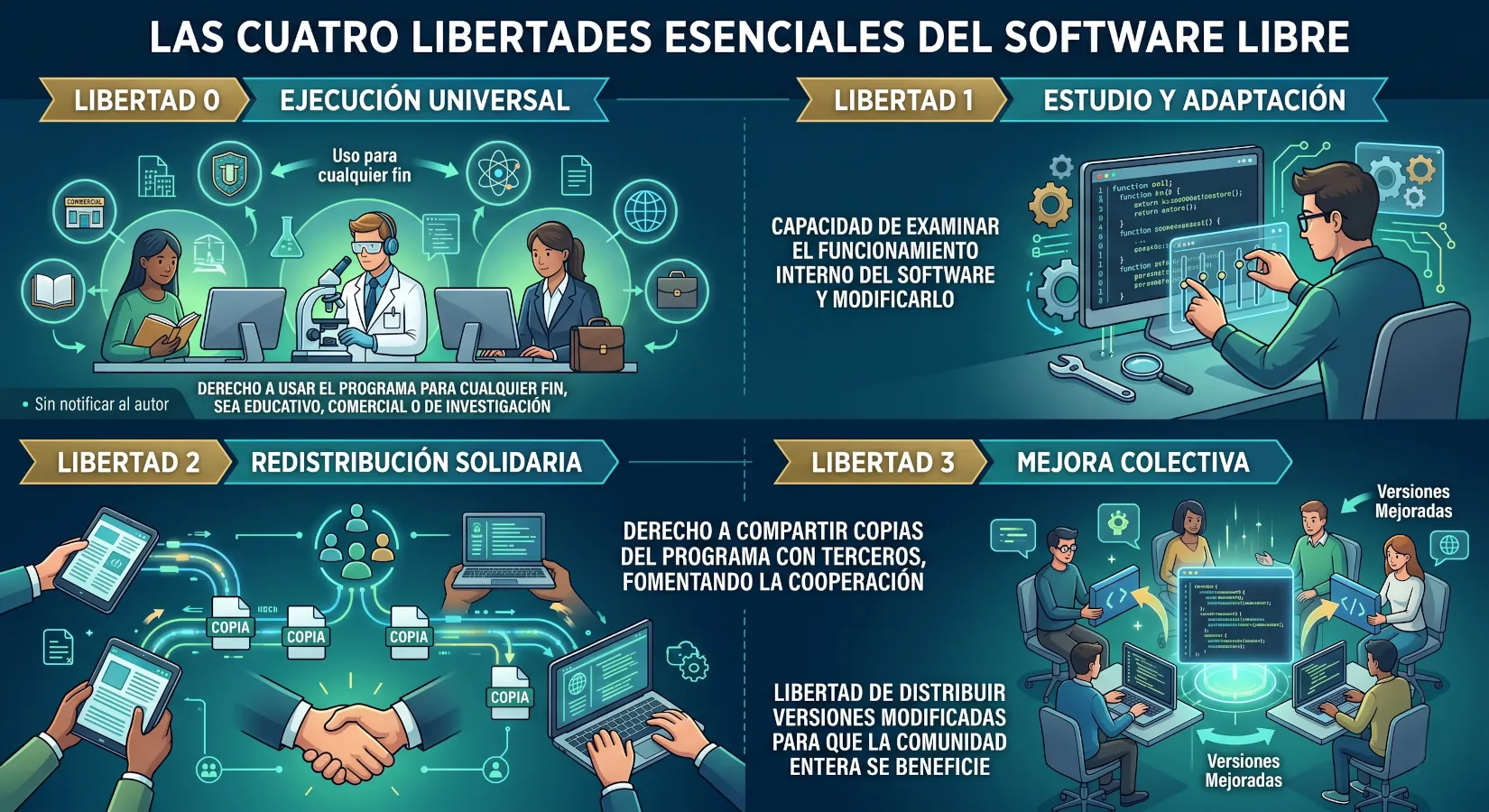
The importance of these freedoms lies in the transfer of power from the developer to the user. In the proprietary software model, the manufacturer decides when to update a program, which features to remove or how to manage the customer's private data.
By contrast, free software enables technological independence, allowing public administrations and companies to decide their own migration and update cycles without submitting to commercial decisions imposed by third parties.
Origins of the movement: From frustration to revolution
The free software movement did not emerge in a vacuum, but as a defensive response to the growing commodification and enclosure of computing knowledge in the late 1970s.
During the preceding decades, at institutions such as MIT and Stanford University, hacker culture promoted the natural exchange of code as a standard scientific practice. Programmers shared their findings to improve the efficiency of systems, seeing software as a tool for collective research rather than an asset of exclusive ownership.
However, the landscape changed drastically when companies began to perceive the commercial value of software separately from hardware. A negative milestone in this transition was the decision by Bill Gates and Paul Allen to impose use licenses on Altair BASIC in 1976, prohibiting enthusiasts from copying and sharing the source code. This paradigm shift turned software into an opaque and restrictive product, which generated deep frustration in the academic community that depended on collaboration to move forward.
But the definitive catalyst for the formalization of the movement was Richard Stallman's personal experience at MIT. Unable to repair a printer's software due to a confidentiality agreement imposed by the manufacturer, Stallman identified a moral dilemma.
His response was not merely technical, but political: he decided to create a complete operating system that would be entirely free, launching the GNU Project in 1983. This effort sought to recover the spirit of cooperation that was disappearing under the weight of proprietary licenses.
Central banks, Wall Street and Silicon Valley vie to govern the internet's money
Evolution and consolidation of the free ecosystem
The 1990s marked a turning point with the emergence of the Linux kernel, developed by Linus Torvalds. While the GNU Project had created most of the tools needed for an operating system, its own kernel, Hurd, was significantly behind schedule in its development.
It was the combination of Torvalds' kernel with Stallman's tools that gave rise to the GNU/Linux system, a robust platform that proved that the decentralized development model could surpass in quality and security the commercial systems of the time, and that has now become the foundational base of our technology.
But as the ecosystem grew, two philosophical currents emerged that, although they shared the same code, differed in their rhetoric and goals. The Free Software Movement, led by the Free Software Foundation, kept its focus on ethics and freedom as moral imperatives.
By contrast, in 1998 the term Open Source emerged, promoted by figures such as Eric S. Raymond (better known as ESR), which sought to attract the business world by emphasizing the pragmatic benefits of transparency, such as cost reduction and accelerated innovation.
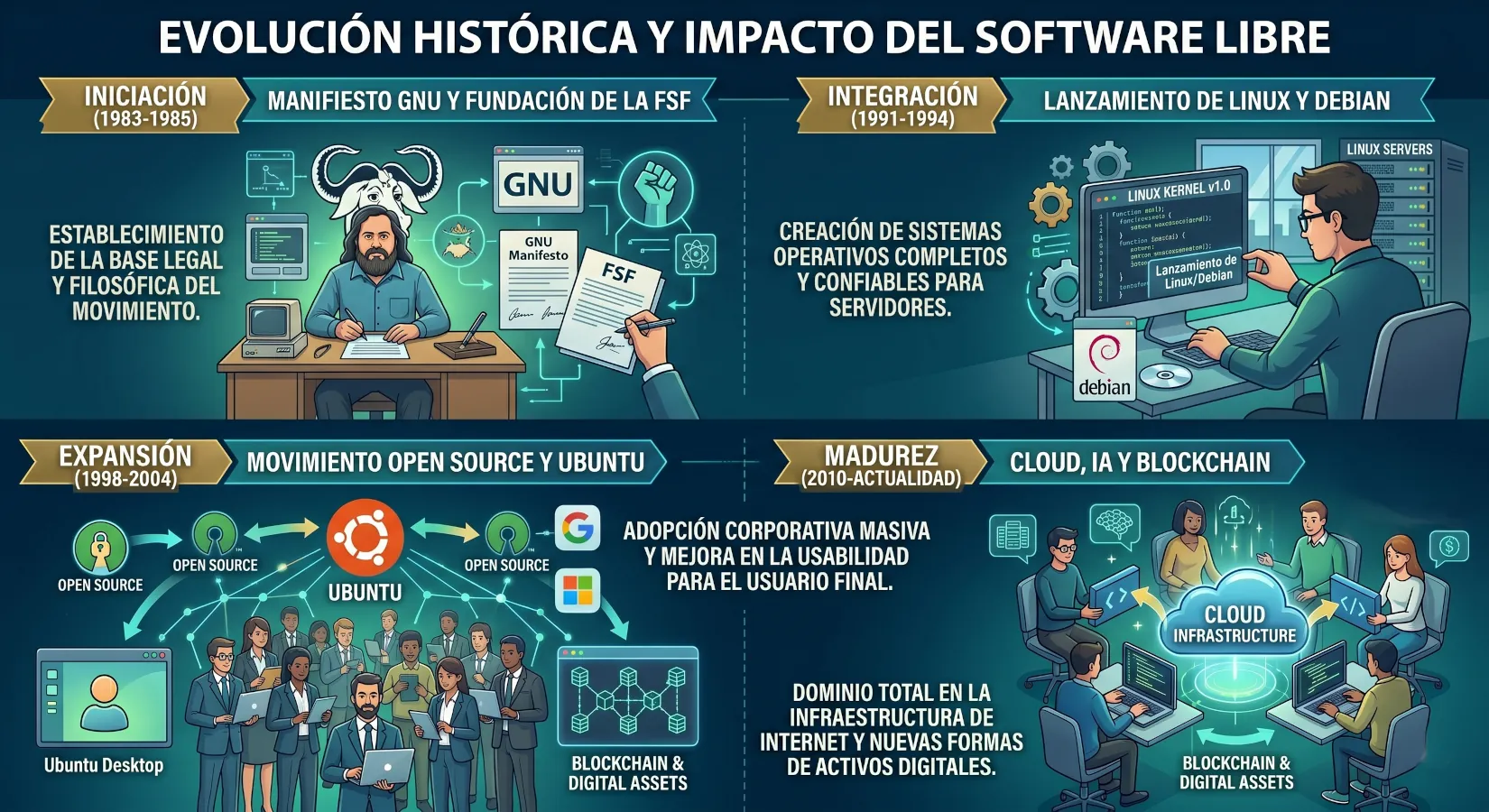
This duality allowed open source to conquer the corporate world, while free software continued to defend users' rights. Companies such as Red Hat proved that it was possible to build profitable business models based on support and customization services, eliminating the institutional fear of depending on software without a traditional commercial «owner».
Today, the critical infrastructure of the network, from Apache web servers to the databases that sustain financial markets, runs fundamentally on free technologies.
The influence of free software on the technology industry is so ubiquitous that today it is practically impossible to find a digital service that does not use it. This transformation has enabled an unprecedented pace of innovation by removing barriers to entry for startups and independent developers, allowing them to build on the shoulders of giants without incurring prohibitive licensing costs.
Network infrastructure and servers
For example, free software's dominance in internet infrastructure is absolute. Approximately 92% of high-performance computing systems and 85% of the servers that move the global economy run on GNU/Linux distributions.
This massive adoption is due to the stability, security and transparency that open source offers, allowing system administrators to audit every line of code to prevent vulnerabilities and optimize network performance.
The cloud and AI revolution
Want another example? The giant Netflix uses FreeBSD to serve its millions of users globally, FreeBSD being a free software operating system that, although different from GNU/Linux, has a similar philosophy, and even a much more permissive one in terms of licensing.
This makes clear that cloud computing, which underpins services from video streaming to e-commerce, has been possible thanks to the use of open source. In fact, tools such as KVM and OpenStack have allowed providers like AWS or Google Cloud to manage massive data centers with an efficiency impossible to achieve with proprietary software. In other words: these companies make money thanks to free software.
And the same situation is repeated with the rise of Artificial Intelligence, which has been driven by open models such as Llama and Mistral, which allow companies to develop their own AI agents while maintaining sovereignty over their data and avoiding dependence on foreign tech giants.
Why does AI consume 1000% more energy than a traditional Google search?
But the impact goes far beyond the tech world; the financial industry has also undergone a radical metamorphosis by integrating the principles of free software into its core operations. What began as a search for technical efficiency has become a complete redefinition of how value is exchanged and stored, culminating in the emergence of decentralized financial systems verifiable by code.
Corporate adoption and Open Finance
The traditional banking sector has moved from a stance of rejection toward free software to one of active collaboration. Through consortia such as the Fintech Open Source Foundation (FINOS), the world's major banks mutualize the development costs of non-competitive infrastructures, such as regulatory compliance systems and common data models. This strategy not only reduces expenses, but also improves the resilience of the global financial system by standardizing security and audit protocols based on open source.
The trend toward «Open Finance» uses open source APIs to allow consumers to have greater control over their financial data. By allowing different applications to interact securely, competition and innovation are encouraged, making it easier for new technology companies to offer personalized services that were once the monopoly of traditional banks. This data transparency is the first step toward a more inclusive and efficient financial infrastructure.
The revolution of digital assets and blockchain
But perhaps the most disruptive impact of free software on finance is blockchain technology. A blockchain protocol is, in essence, open source software that acts as a distributed and immutable ledger, enabling digital asset transactions without the need for a central authority.
This technology uses advanced cryptography to guarantee the integrity of each token, allowing trust to shift from institutions to mathematics and auditable code.
- Disintermediation and costs: By eliminating the need for intermediary banks to validate transactions, blockchain significantly reduces fees and speeds up international payment settlement from days to minutes.
- Smart contracts: Free software makes it possible to program self-executing agreements that manage a cryptoasset autonomously. These smart contracts facilitate the creation of lending, insurance and custody services that operate transparently and without the possibility of human manipulation.
- Financial sovereignty: The combination of open source and decentralized networks enables self-custody of each digital asset. The user holds total control of their funds through private keys, eliminating the risk of a financial entity arbitrarily blocking their resources.
The emergence of Decentralized Finance (DeFi) represents the culmination of this trend. By building an entire ecosystem of financial services on open and public code, it ensures that anyone with an internet connection can access investment and credit tools.
This model not only seeks to democratize access to capital, but also introduces a level of radical transparency where every transaction and protocol rule is visible to any auditor in real time.
Spain's DeFiRe Labs creates a «panic button» against crypto robberies
The Future: Digital sovereignty and transparency
The trajectory of free software indicates that the future of technology and finance will be increasingly open and decentralized. The transition toward an economy based on verifiable code is not just an efficiency improvement, but an evolution toward individual sovereignty in the digital environment.
In a world where algorithms make critical decisions about our finances and freedoms, the ability to audit and modify that software becomes a fundamental requirement for democracy.
Thanks to this, free software has transformed the world by proving that open collaboration is more powerful than corporate secrecy. From Stallman's first compiler to the complex protocols of every current cryptoasset, the common thread has been the conviction that knowledge must be shared.