The AI world is adjusting, and everything seems to point to China wanting to win the competition with economical models, against the West and its costly and apparently overvalued models. This is what the recent Stanford AI Index, has made clear: the United States' technical advantage over China has narrowed to a minimum of 2.7%, eliminating the performance gap that previously existed. And all because while the West sustains astronomical financial valuations, the Asian bloc is winning the game through operational efficiency, offering the use of artificial intelligence at much lower and more accessible prices.
This situation has given rise to what is already known in the sector as "The Great Adjustment", a situation that has caused the market to stop rewarding promises and start demanding real revenue. And the idea that being a leader requires infinite investment in equipment and processors has become obsolete thanks to labs like DeepSeek, which achieve similar results with far less spending. An efficiency that has shaken the stock market, hitting chipmakers and forcing software companies to change the way they charge.
But it doesn't end there. The union of artificial intelligence with digital identity systems and programmable payments is creating a new economy where AI systems operate with financial autonomy. A situation that not only changes how companies work, but completely redefines trust in the digital world and the strategic vision of the AI sector.
Goodbye to cheap AI: now it's your turn to pay the training bill
Market valuations versus operational efficiency
And in that sense, the disparity in the valuation of artificial intelligence companies between the United States and China reflects two opposing visions of that digital future. In the West, the narrative has been built on the basis of compute scarcity and the dominance of proprietary models, which has inflated investor expectations to levels that some analysts consider unsustainable. OpenAI, with a valuation of $852 billion, and Anthropic, which receives offers of up to $800 billion, represent the spearhead of a model that requires an IPO price of at least $1.2 trillion to justify its current capital structure.
The funding gap is so wide that the valuation sought by DeepSeek, one of the most disruptive companies of the moment, represents barely a minimal fraction of the market value of its US competitors. Because, while Silicon Valley firms seek valuations that presuppose a future monopoly, the Chinese lab is seeking just $10 billion, focusing on sustainability and market capture through low prices.
But the danger of that is not only that DeepSeek manages to reach its funding quickly, but that by doing so, with another coup like the one it pulled off with the launch of its first major AI model: DeepSeek V3, and then with DeepSeek R1 (December 2024 and January 2025).
The AI "Revenue Hole" in the West
This situation makes clear the critical point of AI in the West: the revenue hole. Moody's, Sequoia and other financial analysts call it that way: the "small" revenue problem that AI companies in the West currently have: basically they are burning about $600 billion a year.
This figure represents the critical disconnect between massive spending on technology infrastructure and the direct returns obtained from end users. In 2026, capital expenditure (Capex) by the main "hyperscalers" will exceed $527 billion, equivalent to almost 25% of total spending on capital goods across the entire US market.
Unlike previous investment cycles, where spending was financed with operating cash flow, in 2026 a significant part of this expansion is being financed through debt. And in that sense, if interest rates remain high, the cost of debt service could suffocate companies that already face downgrades in their credit outlook, as is the case with Oracle and OpenAI itself.
Basically, this over-provisioning pattern is comparable to the excessive fiber-optic rollout in the late 1990s, where much of the installed physical capacity sat idle after the dot-com bubble collapsed.
Yes, many analysts try to sell the story that AI is not a bubble, that everything is fine, that it's only companies' money being burned. But the reality is that, in the midst of such an intertwined economic and financial system, the result of such actions is the same, and may even be worse, given the magnitude of current spending.
The DeepSeek shock: The demolition of the hardware dogma
To this is added the fact that the competitive landscape is changing rapidly. In fact, DeepSeek proved that it was possible to achieve elite performance using only 2,000 Nvidia H800 chips and a training budget of approximately $5.6 million, a negligible figure compared with the billions invested by US labs to obtain similar results.
This event not only affected the credibility of investment projections, but also caused Nvidia to suffer the largest daily loss in the history of financial markets, evaporating $600 billion in market capitalization in a single day.
Why Anthropic's AI is today more lethal to the crypto sector than the quantum attack
Price war in APIs and global adoption
And at this point the situation twists even further in China's favor. Basically, AI labs in China have been able to replicate the West's level of AI. Far from the accusations around DeepSeek V3 about "theft and unauthorized use of OpenAI models to train V3," models like Kimi, Minimax and GLM have demolished that idea.
Added to this, China's low-price strategy has caused what analysts call the "commoditization of intelligence". On platforms like OpenRouter, Chinese models such as MiniMax, Kimi and DeepSeek have precisely surpassed their US rivals in total token consumption, capturing 61% of global traffic at the end of the first quarter of 2026. The decisive factor is cost: Asian models are between 10 and 20 times cheaper than the alternatives from Anthropic or OpenAI for tasks of equal complexity.
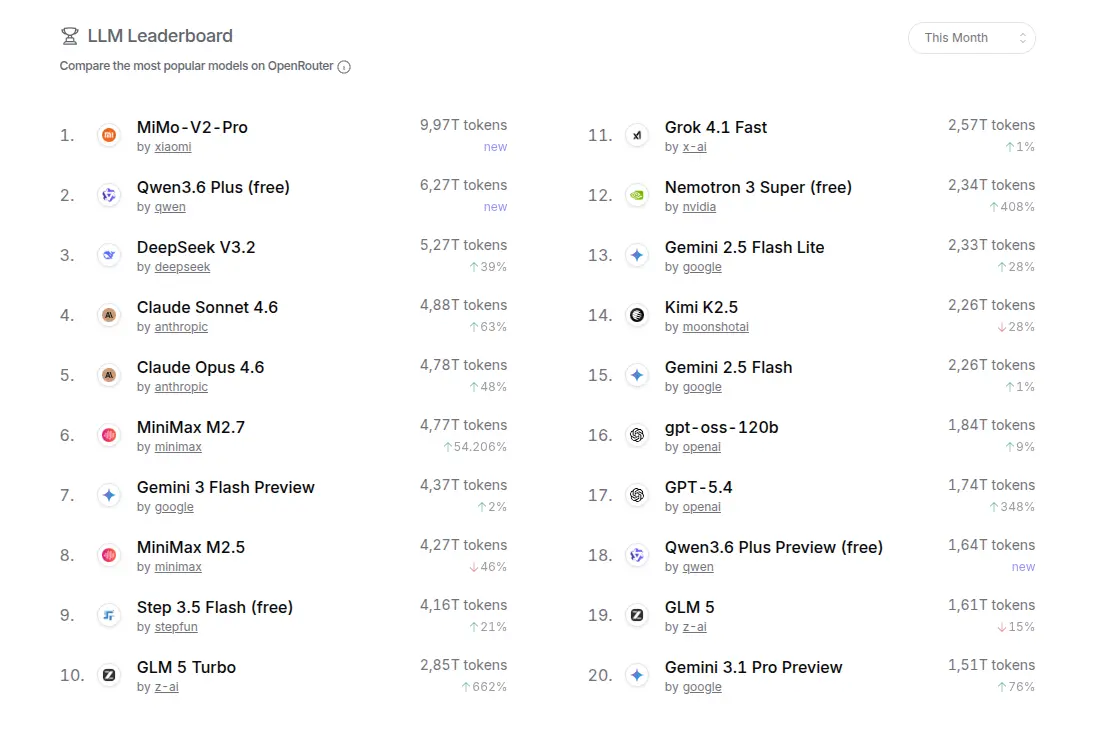
This price differential is particularly critical for the development of autonomous agents, which require processing massive volumes of data continuously. And approximately 80% of new AI companies using open source architectures have migrated their workflows to Chinese models to survive economically in an environment of reduced margins.
Chinese pragmatism
Thus, the West faces the challenge of justifying its billion-dollar valuations through real monetization that exceeds massive Capex and the energy crisis. And in that case, the resilience of the US model will depend on its ability to attract global talent and on its dominance in the design of chip architectures that can compete with the efficiency of Asian labs.
How Blockchain and AI are creating the world's first autonomous financial infrastructure
China, for its part, has shown that pragmatism and extreme optimization are powerful weapons in a global price war. And if it keeps playing those cards, improving its models and above all, accelerating the development of its own hardware, the AI race will have a clear winner and it will not be the West.