In the previous article we analyzed how Vitalik Buterin has begun to set limits to prevent Ethereum from being absorbed by banking and the financial industry traditional. That risk is brewing in the technical heart of the network. In staking and in the way the move of the aforementioned blockchain to proof of stake has been concentrating validation power.
For years Ethereum presented itself as the world's great computer, a global public infrastructure capable of executing code, coordinating contracts and moving value in a neutral, open and permissionless way. In that narrative of being more than a blockchain, there was talk of the promise of the internet of money and of a machine shared worldwide and accessible to anyone, with no owners or dominant intermediaries.
The move from proof of work to proof of stake
During its early years, Ethereum ran on proof of work, a system similar to Bitcoin's, based on mining. Power was distributed among thousands of miners, specialized hardware and costly energy costs. It was not a perfect model, but the barrier to entry was physical, expensive and hard to concentrate quickly. Control was fragmented by design.
Everything changed in 2022 with The Merge, the upgrade that merged the main network with the Beacon Chain, switching the consensus mechanism from Proof of Work (PoW) to Proof of Stake (PoS). Since then, the network is no longer secured with energy, but with capital. To validate blocks, you have to lock up ETH, and whoever holds the most ETH, or concentrates the most third-party ETH, gains more economic and operational weight within the system.
The change brought a drastic reduction in energy consumption, greater efficiency and a more flexible technical architecture. But it also meant, as many warned at the time, that Ethereum's security would depend directly on financial incentives.
The internet as precedent
That is where the problem Vitalik is now trying to correct began, and which since the start of 2026 has led him to write in a tone more aware of the issue. His recent texts, which Observatorio Blockchain has been reporting on, are a structural warning, not a technical one.
Vitalik's concern has a clear precedent in the internet. The network has never stopped being technically open, because no one owns the TCP/IP protocol. However, the real experience of the internet is mediated by an ever-smaller number of private companies. Amazon controls a substantial part of the world's physical infrastructure through AWS. Millions of media outlets, public administrations, startups and digital platforms depend on its data centers. Google organizes access to information through its search engine, mobile operating system and critical services. Meta absorbed much of global social communication.
These companies did not change the internet. They made it indispensable by capturing millions of users, data and decision-making capacity without touching the base protocol. The result is a network that is neutral in theory but operates through private intermediaries, subject to regulation, commercial interests and unilateral decisions. However, in the case of the internet, concentration has occurred in the upper layers, with applications and services, while the base protocol has survived intact. In Ethereum, concentration is occurring in the validation system itself, which is the heart of the aforementioned blockchain.
Validating Ethereum means deciding which blocks enter the chain, in what order and under what conditions. That power is exercised through staking, the mechanism by which validators lock up ETH to secure the network, earning economic rewards in return. Well, after the move to proof of stake, that power became directly tied to capital.
Who controls Ethereum staking today
Today, Ethereum has close to 36 million ETH in staking, a figure that represents around 30% of all ether in circulation. Never before had such a significant share of the network's economic value been directly committed to its security. This means that validating Ethereum, a core function of the system, is supported by tens of billions of dollars locked up permanently.
That volume of capital inevitably changes the nature of the debate. When almost a third of all existing ether is committed to the network's security, the question stops being how many participate in staking and becomes who does it and under what conditions. Consensus turns into a point of concentration of economic, operational and political power.
According to Dune Analytics, six identifiable players control around 52% of staked ETH, a very high proportion for a network that aspires to function as neutral public infrastructure. Lido leads the group with about 24%, operating as a major aggregator that channels capital to professional validators. It is followed by Binance, with around 9%; ether.fi, just over 6%; Coinbase, around 5%; Rocket Pool, with approximately 4%; and Kraken, close to 3.8%.
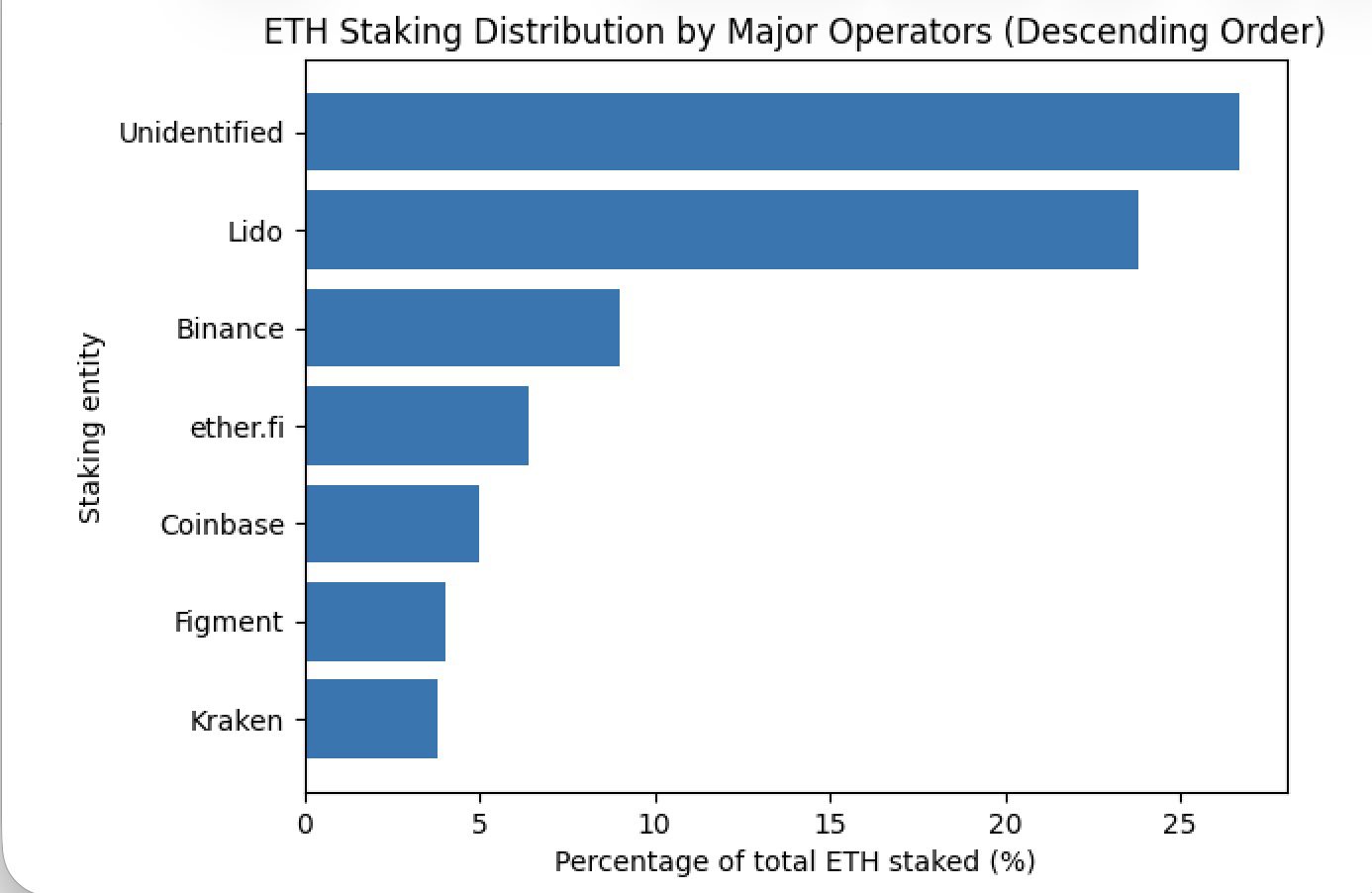
On top of this visible majority, more than a quarter of staking remains unidentified, a category that includes professional operators and institutional custodians without clear public attribution. These are not necessarily small independent validators, but an opaque layer of infrastructure that also participates in consensus.
None of these players controls Ethereum on its own, but together they shape its day-to-day operation. They are, in practice, the ones who decide which versions of the software run, how protocol upgrades are applied and how to respond to sanctions, technical failures or regulatory changes. And they are also the ones who concentrate the system's economic rewards. Not because they have formal power over the protocol, but because they are the ones keeping it operational under real conditions.
In this context, a key difference with the internet emerges: in Ethereum, consensus pays. Staking moves billions of dollars a year in rewards. That is, whoever controls more staking earns more money. Whoever earns more money can invest in better infrastructure, and whoever has better infrastructure attracts more staking. It is the direct result of proof of stake's economic design, where the network's security has become a market.
A simpler Ethereum
When that market is dominated by regulated players, with headquarters and legal obligations, the network becomes sensitive to external pressure. There is no need to rewrite the protocol to apply censorship, prioritize transactions or adapt to specific regulatory frameworks. At the center of this debate is a concept Vitalik has been repeatedly stressing: latency. If a validator does not receive a block on time or does not sign within the expected interval, it loses rewards or is penalized.
Large companies can afford optimized data centers, private networks and specialized equipment to minimize that latency. Small operators cannot. Every improvement in technical efficiency favors those who already have resources, silently pushing out the rest. Optimizing for speed, Vitalik warns, is optimizing for concentration.
The response Vitalik proposes is a simpler Ethereum, with fewer external dependencies and manageable technical requirements. A system that uses rollups and sharding to scale without overloading the base layer and that does not turn validation into an exclusively corporate activity. The goal is not to push out the industry, but to prevent it from becoming the system's only real support.
Large volumes of capital
In this scenario of an Ethereum sustained by large volumes of capital and operators of global scale appears Obol. This company develops distributed validator technology that allows a single validator to be operated by several independent people or entities, sharing keys and responsibilities through threshold systems.
However, Obol does not operate outside the industry that currently concentrates staking. Among its partners are central players in the ecosystem such as Lido or ether.fi, as well as specialized venture capital funds such as Pantera Capital, Archetype or Maelstrom. Its proposal does not seek to displace these players, but to reduce the risks their concentration entails. This means that in the Ethereum of 2026, even the solutions designed to contain centralization are already built on the same capital and infrastructure structures that currently sustain the network. Obol's technology currently protects close to $2 billion in locked value, which places it as a relevant infrastructure of the Ethereum ecosystem.
All of this leads to the question of who controls today the financial infrastructure of the future that Ethereum promises. The answer is that no one controls it completely, although a few decisively shape it. Validation and, with it, the practical conditions of consensus, are increasingly concentrated in large staking operators. The physical infrastructure runs, to a large extent, on the cloud of Amazon, Google or Microsoft. States do not control the code, but they do regulate the companies that run it. The result is a network that remains open and global, but whose operation depends on centralized players.
Vitalik, staking, latency and validators
Vitalik knows he cannot decentralize all layers at once. But he also knows that if the consensus layer ends up definitively shaped by a few, no later correction will be enough. The internet never had this conversation in time. Ethereum, still, can. That is why, in 2026, the debate Vitalik raises about staking, latency and validators is not about efficiency and scalability. It is about who will have the real power to decide how the financial infrastructure of the future will work.