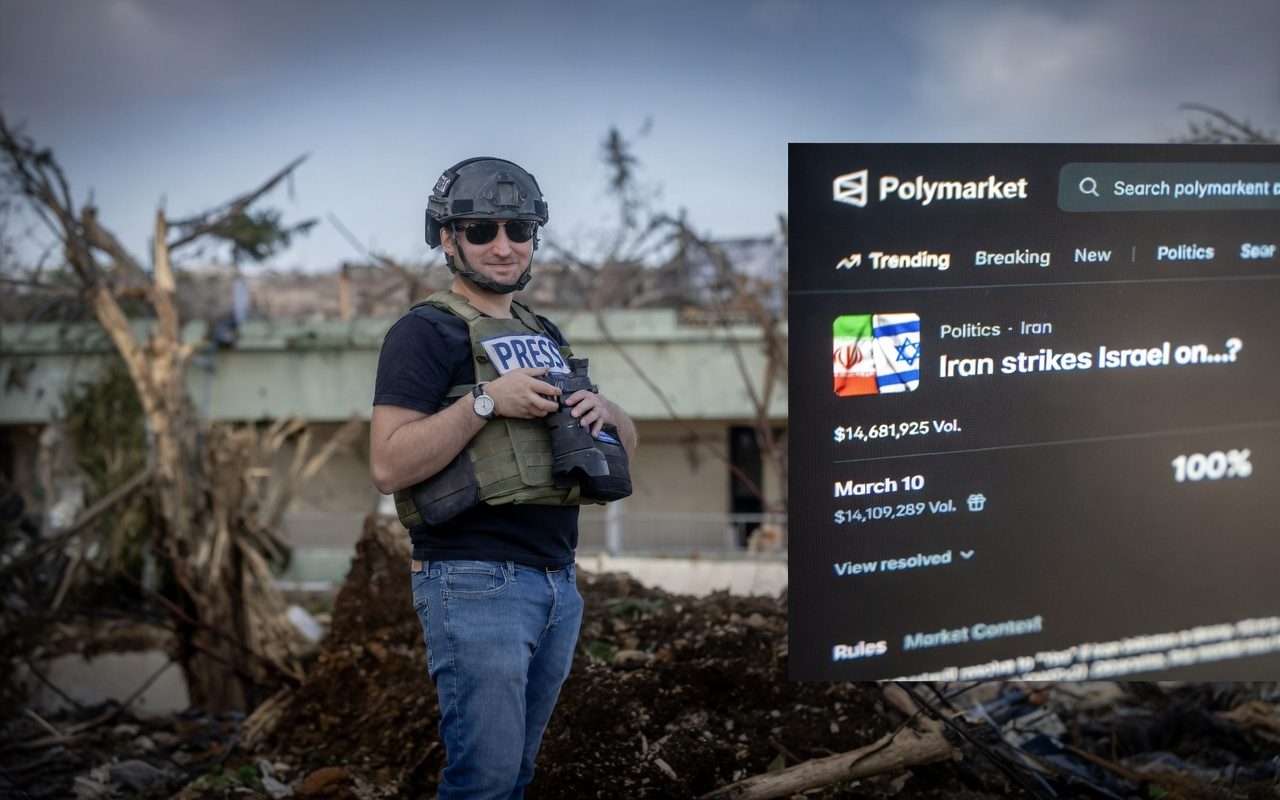
Emanuel Fabian, a journalist at The Times of Israel, has reported that bettors on the cryptocurrency platform Polymarket swear they will kill him if he does not rewrite a story about Iranian missiles. "Te q86 minutes left. You are the only one responsible for your life». The journalist reported that eLast March 10, an Iranian ballistic missile fell in an unpopulated area near Beit Shemesh and that the projectile had hit the ground, causing a large explosion.
What Fabian did not know was that at the same time, more than 14 million dollars had been bet on Polymarket on whether Iran would attack Israel on March 10. The rules of the bet stipulated that if the missile was intercepted, even if the debris fell on Israeli soil, the bet would resolve as No. If it hit, it would be a Yes. For those who bet on No, Fabian's report was the only obstacle between them and a fortune.
Extortion and death threats
The journalist denounces that he began receiving messages from individuals demanding that he change his story to say the missile had been intercepted. The pressure escalated to the point that fake screenshots were even created in which Fabian supposedly admitted that his information was wrong. In addition, some of the bettors demonstrated that they knew the address of his home, as well as details about his parents and siblings. Fabian even received an ultimatum in which they told him that "you have 90 minutes to update the lie… after you make us lose 900,000 dollars, we will invest that to finish you off," one of the messages said.
580 million in 48 hours: is it ethical for war to be a market?
Polymarket's response
After the public complaint, Polymarket condemned the events, stating that such behavior violated its terms of service. The platform announced the blocking of the accounts of those involved and indicated that it would hand over all information to the competent authorities.
The incident has given new momentum to those who have long been warning in Washington about the ethics of betting on life and death. Earlier this month, Senator Adam Schiff and Mike Levin, a Democrat in the United States House of Representatives since 2019, introduced the DEATH BETS Act to make it illegal for prediction markets to offer bets on war, terrorism, assassination or death.
"Anonymous bettors have already won millions on prediction platforms linked to the war with Iran. This is morally indefensible and must be illegal. If the CFTC does not act, Congress will," Levin writes on his X account.
To understand the scale of what is happening in these markets, it is enough to look at the catalog of bets offered by Polymarketwhere geopolitical tragedy is served up in speculative markets that range from the strategic to the surreal.
Among the most active bets are predictions on whether the United States will invade Iran before March 31, which specific countries (such as France, the United Kingdom or Germany) will join the offensive, or even details as mundane as whether Supreme Leader Khamenei will post a tweet on a given date. This gamification of war not only covers troop movements, but also monetizes economic uncertainty with bets on the price of crude oil or the number of ships that will manage to cross the Strait of Hormuz, turning every explosion or diplomatic statement into an event that can win or lose fortunes in a matter of seconds.
Assassination betting houses
All of this comes after Ali Khamenei's death sparked a fierce controversy in prediction markets, where Polymarket and Kalshi, the other major betting platform, reacted in opposite ways to the ethical dilemma of profiting from an assassination.
While the regulated Kalshi froze payouts and refunded 2.2 million dollars out of its own pocket to avoid being labeled a betting house on assassinations, the crypto platform Polymarket distributed 529 million dollars in profits. In addition, suspicions of insider trading emerged, with users who came to win more than 550,000 dollars.