The emergence and technical operation of WebAssembly (Wasm)
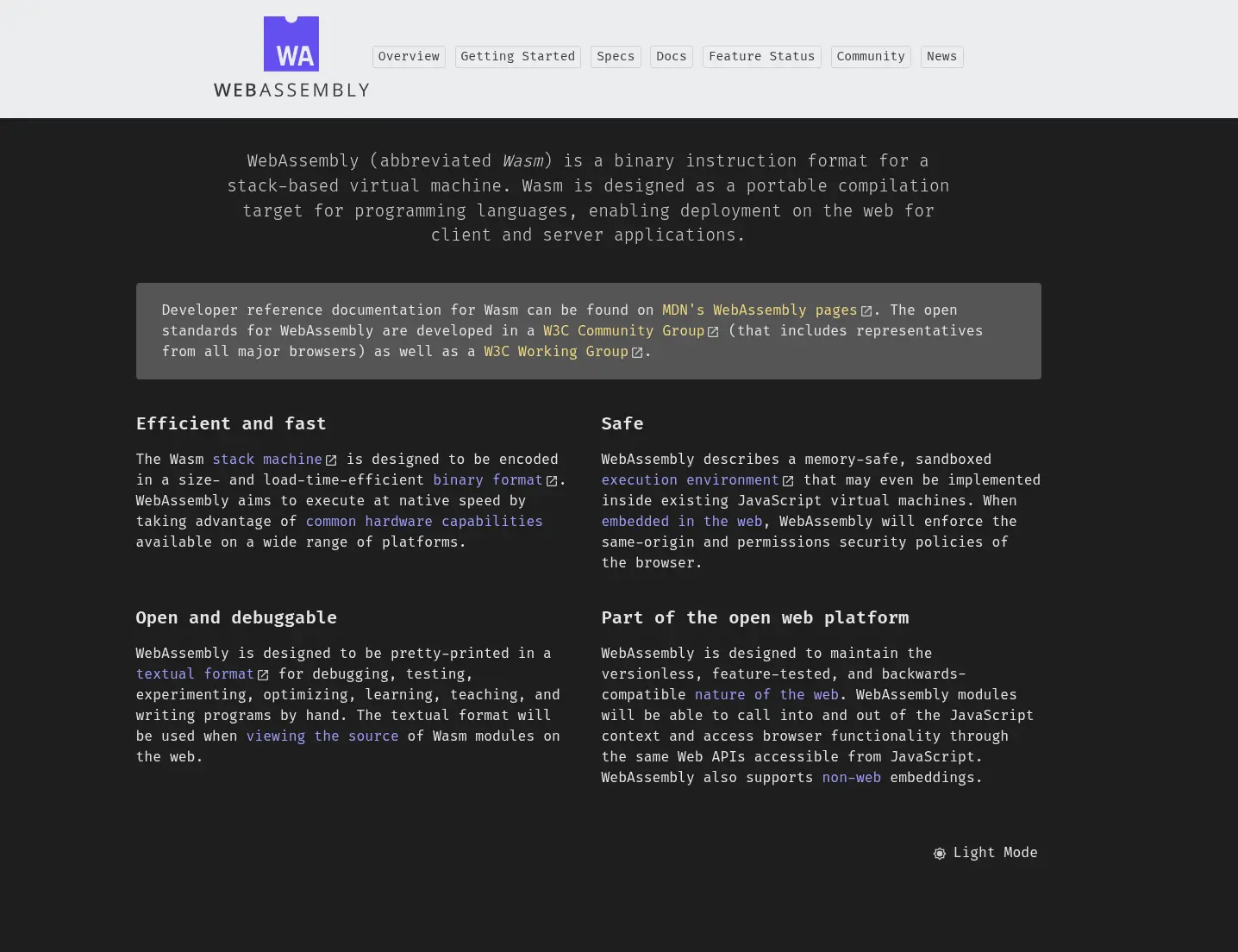
WebAssembly (Wasm) is a portable low-level binary instruction format designed to run inside a stack-based virtual machine. It was originally conceived in 2015 as a collaborative effort among the main web browser vendors, including Mozilla, Google, Microsoft and Apple, in order to overcome JavaScript's performance bottlenecks in complex web applications. Its official launch in March 2017 enabled code to run at speeds close to those native to the processor, opening a new era in software design for browsers.
Why will your next ID be a crypto wallet?
At a technical level, the Wasm specification stands out for operating directly with four fundamental numeric types: 32- and 64-bit integers (i32 and i64), and 32- and 64-bit floating-point numbers (f32 and f64). These numeric types have an almost direct equivalence with the CPU's physical instructions, eliminating additional layers of software translation.
In addition, Wasm uses a linear memory model, which consists of a contiguous, addressable block of random access memory (RAM) capable of expanding dynamically. This approach drastically simplifies the handling of complex data, optimizes computational storage and guarantees fully deterministic behavior, an indispensable requirement for reaching consensus on any blockchain network.
The EVM's inefficiency and Wasm's technical solution
But why so much interest in Wasm in the crypto world? To understand this you should know one thing: the Ethereum Virtual Machine (EVM) is a disaster of inefficiency and limitations.
This is because the EVM is a stack-based execution engine structured in 256-bit words. Although this size facilitates the cryptographic calculations of Ethereum's hash algorithm, it introduces severe structural inefficiency in the real hardware of validator nodes, whose native CPUs operate on 32- or 64-bit architectures.
This means that to execute each EVM instruction, the servers' physical processors must constantly split and reassemble data, limiting performance and driving up processing costs. To mitigate this inefficiency, Ethereum has historically resorted to precompiles to run heavy algorithms (such as SHA256) at a fixed gas cost. However, this approach increases the complexity and structural overhead of the network client without solving the original design flaw.
How Fireblocks could connect European banks with the AI economy
A more optimal solution
By contrast, Wasm delivers exceptional performance thanks to its native compatibility with contemporary hardware specifications. Although Wasm's logical specification is a stack-based machine, modern compilers and execution engines (runtimes) translate this bytecode into native CPU register code (ARM or x86). This drastically reduces redundant memory operations and allows Wasm-based smart contracts to run between 10 and 100 times faster than their traditional EVM equivalents.
However, adopting Wasm in blockchain environments presents technical nuances. A comparative study conducted in 2024, revealed that eWASM implementations (Wasm adapted for Ethereum) were slower than standard EVM ones in certain operations, due to the overhead introduced by gas metering systems and constant context switches. This shows that Wasm's real optimization depends not only on the bytecode format, but also on the architecture of the virtual machine hosting it and the efficiency of the compiler used.
Ethereum and Solana: Two philosophies of integration with Wasm
Although Ethereum's initial plan to migrate directly to eWASM was postponed, Layer 2 scalability solutions have taken the lead in adopting this technology. The most advanced exponent of this trend is Arbitrum Stylus, which implements a secondary Wasm-based virtual machine that coexists equivalently with the standard EVM within the same network nodes. This allows developers to write high-performance smart contracts in languages such as Rust, C, C++ and Move, while maintaining full compatibility with Ethereum's global state and the EVM's existing liquidity.
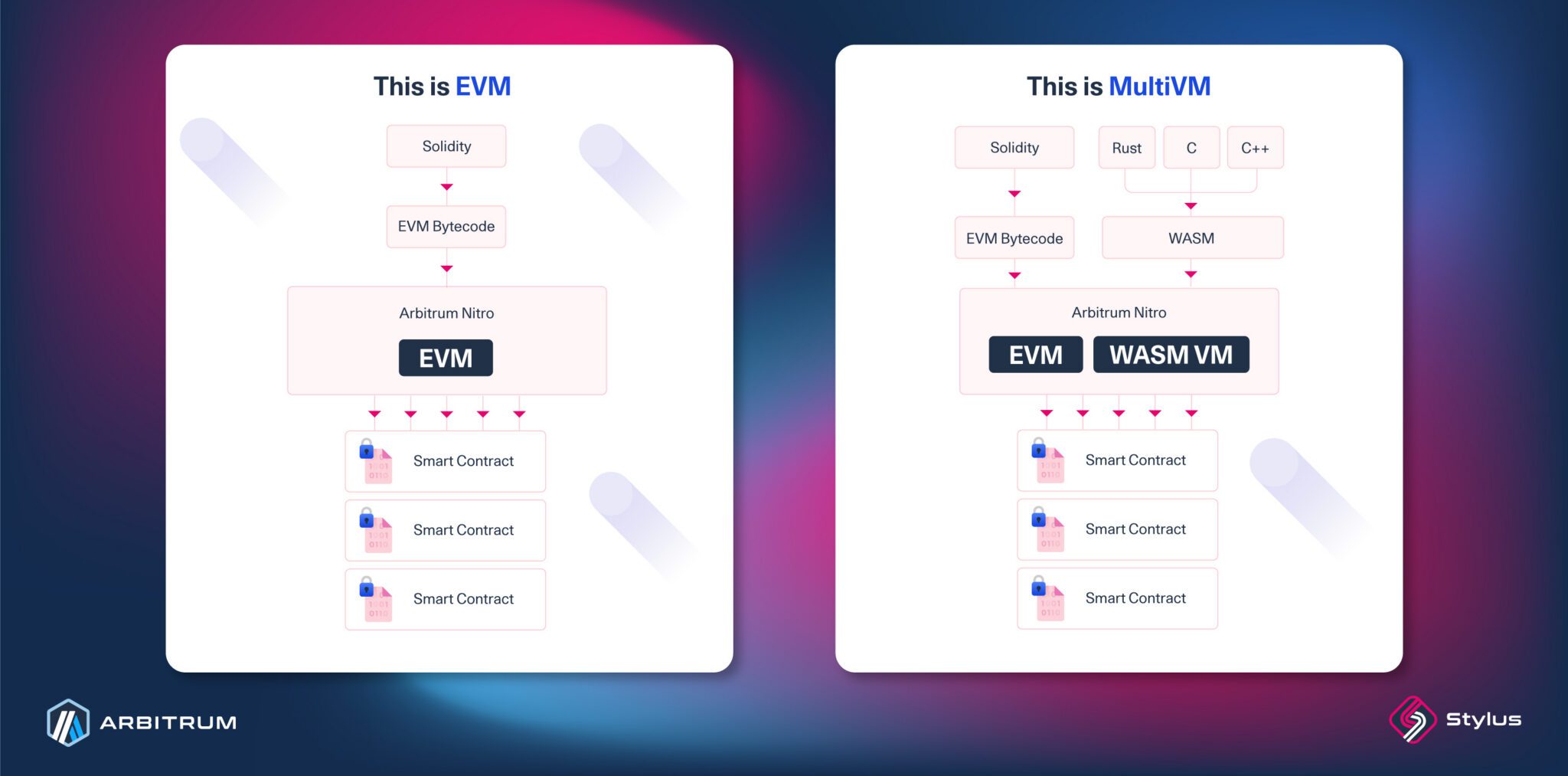
When a Stylus smart contract is invoked, the system routes the transaction to a specialized runtime based on Wasmer, an ultra-high-speed WebAssembly engine. During the prior activation process, the Wasm bytecode is compiled and linked at the node level to run as real machine code. To fund this efficient execution, Stylus introduces a metering system called ink.
This refinement allows computationally complex operations, such as advanced cryptography or on-chain video game logic, to achieve cost reductions of between 10 and 70 times compared with the EVM. To prevent denial-of-service (DoS) attacks or spam on the network, Stylus requires a one-time activation cost of approximately 14 million testnet gas units when deploying and activating a contract for the first time.
Solana and the pragmatic use of Wasm in its development suite
The Solana network takes a different approach to WebAssembly. Solana's native execution engine, the Solana Virtual Machine (SVM), does not run Wasm bytecode on-chain. Instead, Solana compiles its programs written in Rust or C into a secure bytecode format optimized for the Linux kernel called sBPF (a secure variant of eBPF). However, Wasm is a fundamental pillar in Solana's development ecosystem for building client tools and optimizing the user interfaces of its DApps in web browsers.
An outstanding example of this synergy is Alon, an integrated development environment (IDE) that allows building, iterating, testing and deploying DApps on Solana directly from the web browser without the need for remote servers. Alon integrates a Solana compiler and linker ported directly to Wasm via Emscripten, reducing compilation times for complex programs to a few hundred milliseconds on the client side.
Developers also use the Solang compiler based on the LLVM infrastructure. With Solang, it is possible to write smart contracts in Solidity and compile them interchangeably to Wasm bytecode (for Polkadot or Ethereum networks) or to sBPF code optimized to run on the Solana network. Likewise, tools such as Solana's Rust Wallet Adapter compile heavy cryptographic libraries to Wasm to interact natively and securely with browser extensions such as Phantom.
Why companies choose Blockchain in 2026
Advantages of Wasm for advanced DApp development
Adopting WebAssembly as an on-chain execution standard unlocks computational capabilities previously unattainable for digital asset developers. These advantages translate not only into greater speed, but also into security, modularity and accessibility of technical talent.
Massive integration of traditional Web developers
According to global industry estimates, there are more than 27 million software developers worldwide, while the digital asset and blockchain ecosystem has barely around 30,000 monthly active developers.
The EVM forces engineers to learn Solidity or niche proprietary languages. Wasm breaks this barrier to entry by allowing the millions of Rust, C, C++, Go and Python programmers to create advanced smart contracts using the tools they already master and to leverage thousands of existing open source libraries.
Native security with memory isolation (Sandboxing)
Wasm execution environments offer by default an extremely strict sandboxing security scheme. A Wasm smart contract's code runs in complete isolation and has no direct access to the network host's resources, the operating system or the linear memory of other smart contracts.
Any buffer overflow or unauthorized memory access is mitigated during the compilation phase or immediately rejected at runtime by the hardware, preventing the most destructive exploits in the cryptoasset sector, such as those leading to massive DeFi thefts.
The rise of ZK-WASM and verifiable computing
The intersection of zero-knowledge cryptography (ZKP) and WebAssembly has given rise to ZK-WASM, a technology developed by pioneering firms such as Delphinus Labs.
By embedding the logical instructions of a complete Wasm virtual machine inside a zk-SNARK arithmetic circuit, ZK-WASM allows any complex web program written in common languages to run off-chain and generate a cryptographic proof of its correct execution. This proof can be verified on-chain in milliseconds by a smart contract, definitively resolving the scalability and privacy dilemma for data-intensive computational tasks.
Liquid governance and network interoperability
Wasm facilitates the construction of modular networks with automatic upgrade capabilities. In frameworks such as Polkadot's Substrate, the state transition logic of the entire blockchain is compiled into a Wasm module and stored directly on-chain.
This allows protocol upgrades to be made at runtime without the need to coordinate hard forks of the client software. Additionally, the CosmWasm standard within the Cosmos ecosystem demonstrates how Wasm-based contracts can integrate natively with the inter-blockchain communication protocol (IBC), facilitating fluid and direct cross-chain interactions between various sovereign networks.
The weekly crypto pulse: stablecoins, tokenization and macro pressure
Practical applications and games in the real ecosystem
Wasm's technical maturation is reflected in practical software development platforms and in major commercial engines of the Internet industry.
Fantasy consoles and on-chain video games with WASM-4
In the recreational and indie development sphere, WASM-4 has established itself as an open source retro fantasy console that allows creating complete video games compiled exclusively in WebAssembly. The platform stands out for emulating the severe hardware limitations of the last century, forcing developers to squeeze the efficiency of their code and optimize the storage of the virtual cartridge (.wasm). The physical and logical limits of this virtual console include:
- Display: Fixed maximum resolution of 160×160 pixels, with a palette of 4 customizable colors and constant refresh at 60 Hz.
- Execution memory: 64 KB of addressable linear RAM, with direct input/output (I/O) mapping.
- Storage: The size of the compiled virtual cartridge must be less than or equal to 64 KB, with a strict local disk storage space of just 1024 bytes.
Despite these rigid specifications, WASM-4 is capable of running amazing titles in real time through engines written in languages such as AssemblyScript, Zig or Rust. Advanced experiments such as the generation of the Mandelbrot mathematical fractal, the classic block-dropping puzzle Zigtris, the pseudo-3D engine WASMstein 3D, and the tactical strategy simulator Mini Civ, demonstrate Wasm's viability for intensive physics calculations, pixel rendering and multichannel audio processing on microcomputers and mobile device browsers.
World of Wasm and the consolidation of industrial applications
The digital suite World of Wasm comprehensively compiles large-scale commercial implementations that demonstrate the engine's power outside the exclusive cryptoasset ecosystem, serving as a demonstration of the computing capacity that future complex DApp interfaces will inherit. Among the most notable use cases are:
- Figma: The popular collaborative design and vector interface illustration tool ported its main graphics engine written in C++ directly to WebAssembly. This migration reduced initial loading times for complex files, allowing fluid manipulation of heavy vectors by thousands of concurrent designers in real time.
- Google Earth: The dynamic calculation of the three-dimensional globe, which requires compiling massive satellite and topographic imagery in real time, runs directly in the browser thanks to Wasm's binary parallelization power without requiring heavy downloads.
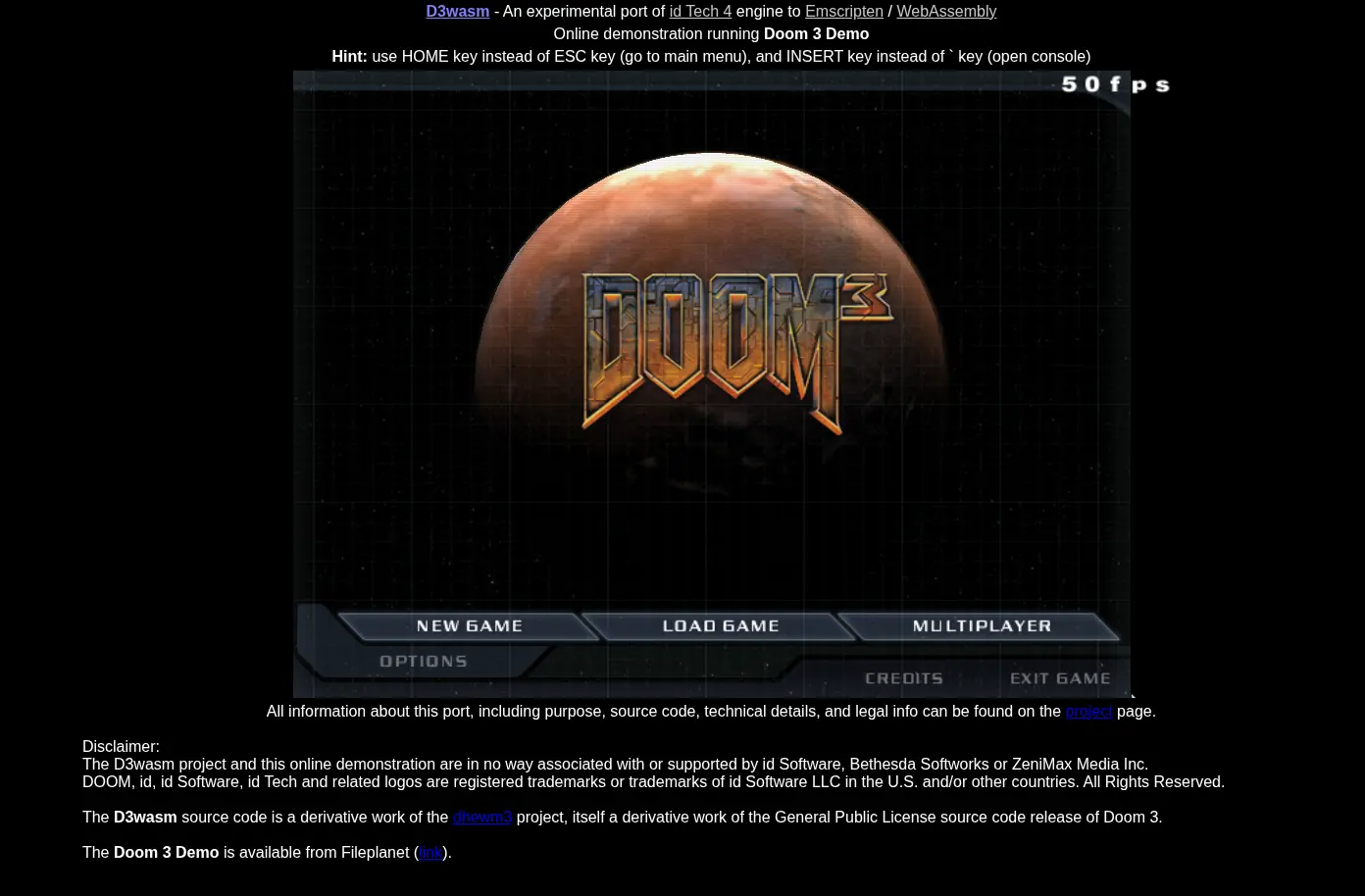
- Arx Fatalis and Doom 3 (D3WASM): High-performance experimental projects such as D3WASM (a port of Doom 3's id Tech 4 graphics engine) and ARXWASM (a port of the 2002 role-playing video game Arx Fatalis) demonstrate how complex code inherited from desktop platforms two decades ago can run unmodified at 60 frames per second inside a secure browser sandbox.
The determinism challenge in blockchain execution environments
One of the most common questions among software engineers is why blockchain networks that use Wasm cannot use super-optimized, proven commercial engines such as V8 (from Google Chrome) or SpiderMonkey (from Mozilla). The answer lies in the rigorous security and determinism requirements of decentralized consensus systems.
Commercial web Wasm engines are optimized exclusively for client execution speed and often sacrifice the strict determinism of certain floating-point operations in exceptional situations to squeeze hardware performance. In a decentralized network, if a single arithmetic operation produces a slightly different result on a node running an Intel processor compared with another node running an AMD processor, the network's consensus will break immediately, which can cause an unwanted fork or the total halt of the blockchain.
AI threatens cybersecurity: Chaos in Linux and software repositories
Additionally, engines like V8 use Just-In-Time (JIT) optimizing compilers. JIT compilation is inherently lazy, optimizes code on the fly during program execution and its computational complexity is not linear. For a digital asset network to charge fair and predictable fees to developers when deploying a contract, the contract code's compilation time must be strictly linear in relation to its size.
More work and development
For this reason, blockchain networks resort to interpreted compilers strictly oriented toward accuracy and security, such as Parity's wasmi, or apply rigorous static analysis and security testing before the on-chain activation phase, as the Arbitrum Stylus validator does in Nitro.
WebAssembly has established itself as the most promising digital asset infrastructure technology for driving mass adoption of the ecosystem. By delivering near-native performance, enabling the use of the world's most widespread programming languages and guaranteeing military-grade sandboxing security levels, Wasm tears down the scalability and technical accessibility barriers that slowed the expansion of the first decentralized networks.
The convergence of this architecture with advanced zero-knowledge cryptography and modern hardware marks the beginning of a new era in which the development of complex on-chain smart contracts and mass-consumer web applications will be indistinguishable to the end user.