For more than a decade, Bitcoin has been revered almost exclusively as "digital gold," an unbreakable store of value that sat static in its holders' portfolios. However, we are witnessing a historic paradigm shift.
The arrival of Bitcoin Finance, known by the acronym BTCFi, seeks to transform this passive capital into an active yield engine, exploring ways to connect the world's most secure network with the decentralized finance ecosystem without altering its security foundations. BTCFi refers to the set of protocols, layers and mechanisms that seek to bring programmable financial uses to Bitcoin. In that sense, BTCFi is the bridge between Bitcoin and decentralized finance, not pure DeFi in the Ethereum style.
Bitcoin's liquidity
This sector is already an economic reality that has shown astonishing traction. In the past year, the BTCFi ecosystem has experienced explosive growth, reaching a total value locked (TVL) of more than 7 billion dollars. Thus, what began as an experimental niche has evolved into a robust infrastructure that enables staking, lending and the generation of native yields without compromising the security of the base layer.
But this is only the tip of the iceberg. With a market capitalization exceeding 1.9 trillion dollars, Bitcoin holds the largest liquidity reserve in the world of digital assets. As this enormous mass of capital begins to flow toward interoperability protocols and Layer 2 (L2) solutions, the expansion potential of BTCFi becomes practically unlimited.
This article explores how the awakening of Bitcoin's liquidity is redefining the rules of DeFi and why BTCFi is positioned as the most lucrative frontier of the next financial era.
FAITH IN BITCOIN GROWS THANKS TO ITS MATHEMATICAL DISCIPLINE, VERSUS KITSCH ABUNDANCE
Bitcoin and its DeFi ecosystem
The term DeFi (Decentralized Finance) refers to an ecosystem of financial applications built on blockchain technology that operate without traditional intermediaries, such as banks or brokerages. Instead, it uses smart contracts (self-executing software) to manage loans, exchanges and yields transparently and automatically.
Although DeFi's roots go back to the creation of Bitcoin itself in 2009, the sector really exploded in 2020, with the famous "DeFi Summer," on the Ethereum network. For years, while other chains developed complex tools, Bitcoin stayed on the sidelines due to its simple and ultra-secure design, focused on immutability rather than programmability.
However, technological evolution has changed the rules of the game:
- Custody Stage (2009-2018): Bitcoin is purely a store of value.
- Wrapping Stage (2018-2021): "Wrapped" Bitcoin appears (such as WBTC or Wrapped Bitcoin) to be used on Ethereum.
- BTCFi Era (2021-Present): Thanks to innovations such as the Ordinals protocol, Layer 2s (L2) and Restaking, Bitcoin can now generate yield natively or quasi-natively, allowing its holders to put their capital to work without selling their assets.
Main protocols in the ecosystem
This reality is reflected in DeFiLlama data, where we can see the main protocols that are absorbing Bitcoin's liquidity and leading the ecosystem by Total Value Locked (TVL):
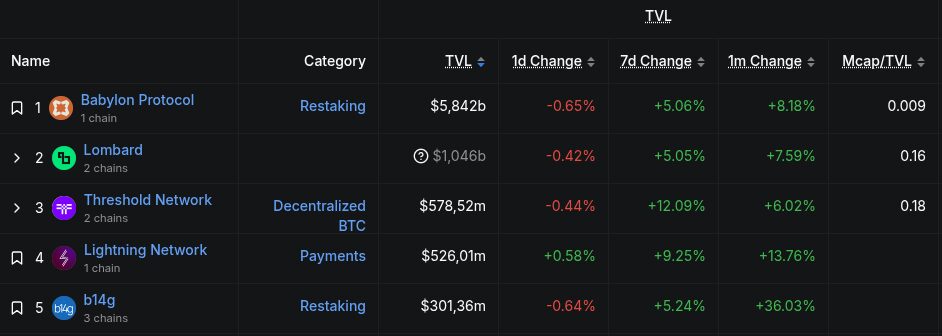
But despite the impressive figures reached recently, the BTCFi sector is barely in its "early expansion"phase. If we analyze the fundamentals, what we are seeing is the laying of the foundations of a new financial superstructure.
Gap between capitalization and use
In this sense, the most revealing metric of BTCFi's potential is the ratio between its Total Value Locked (TVL) and Bitcoin's total market capitalization. While on networks such as Ethereum TVL usually represents a significant percentage of its total value, on Bitcoin, that 7 billion dollars in BTCFi TVL is barely a minimal fraction (less than 1%) of its 1.9 trillion capitalization for all of Bitcoin.
This makes it clear that, if Bitcoin were to approach the capital efficiency achieved by the main DeFi ecosystems of other blockchains such as Ethereum, the potential size of the BTCFi ecosystem would not be measured in billions, but in hundreds of billions of dollars..
BITCOIN, THE NEUTRAL ASSET VERSUS THE DEBT INTERESTS THAT DEVOUR BUDGETS
Driving adoption among "HODLers"
But for that to happen, one last frontier must be crossed: long-term and purist Bitcoiners must adopt these solutions. Historically, the Bitcoin user has prioritized cold custody and inactivity (HODL), two things that lead them to operate very firmly on the Bitcoin chain itself.
Using Ethereum or Solana to operate "DeFi on Bitcoin" sounds like sacrilege to bitcoiners and many of them reject it outright. First, they are not willing to use other chains to operate with something that is "sold or presented" as DeFi on Bitcoin. Second, most of those protocols depend on very complex operations, which do not appeal for usability and hacking risks.
In search of native solutions
The solution? Developing native solutions on Bitcoin that allow for better security and integration with the Bitcoin ecosystem as such. Hence, as non-custodial staking protocols and proven security solutions emerge, cultural resistance is fading. After all, the incentive of earning a yield in "the hardest currency in the world" is a magnet too powerful to ignore.
Perhaps the best example of this is Babylon, a BTCFi protocol that is the undisputed king in this sector, a place it has been able to reach because this protocol allows native BTCFi operation on Bitcoin, using wallets such as Unisat, or directly hardware wallets such as Ledger.
But those solutions will have to wait a while. Options such as Citrea, BitVM, RGB or even Lightning Network have very pronounced limitations that, for now, do not make them suitable for such developments.
Finance on Bitcoin
Therefore, on that path toward full sovereignty of finance on Bitcoin, we find ourselves in a fascinating transition period where innovation does not wait for the base layer to be completely transformed. This interlude is led by intermediate solutions that, although they do not operate strictly natively on the main network, maintain an umbilical link with its security and liquidity.
Projects such as Stacks, which introduces smart contracts linked to Bitcoin's state, or StarkNet, which explores scalability through zero-knowledge proofs, act as living laboratories. These technologies allow Bitcoin's capital to start circulating in agile and programmable environments, demonstrating that the robustness of the reigning currency can coexist with the flexibility needed for the DeFi ecosystem.
TOKENIZATION, STABLECOINS AND DEFI WILL REDESIGN THE FINANCIAL SYSTEM IN 2026
Education stage
But the true value lies in how these tools are democratizing access to complex financial strategies that were previously inaccessible to the average user. By reducing technical barriers, these intermediate platforms are preparing the ground for mass adoption, allowing the community to experiment with yield and utility without having to wait for structural changes in the original protocol. It is a stage of preparation and education where the infrastructure becomes more friendly, transforming the perception of Bitcoin from a static asset to a dynamic and multifaceted resource.
Within this ecosystem of solutions that simplify the user experience, Brovestands out especially. This platform embodies the evolution of this interlude by offering a unified interface that allows interacting with various BTCFi protocols from a single place. Instead of navigating the technical fragmentation of multiple networks and applications, Brove acts as an intuitive bridge that centralizes yield and asset management opportunities.
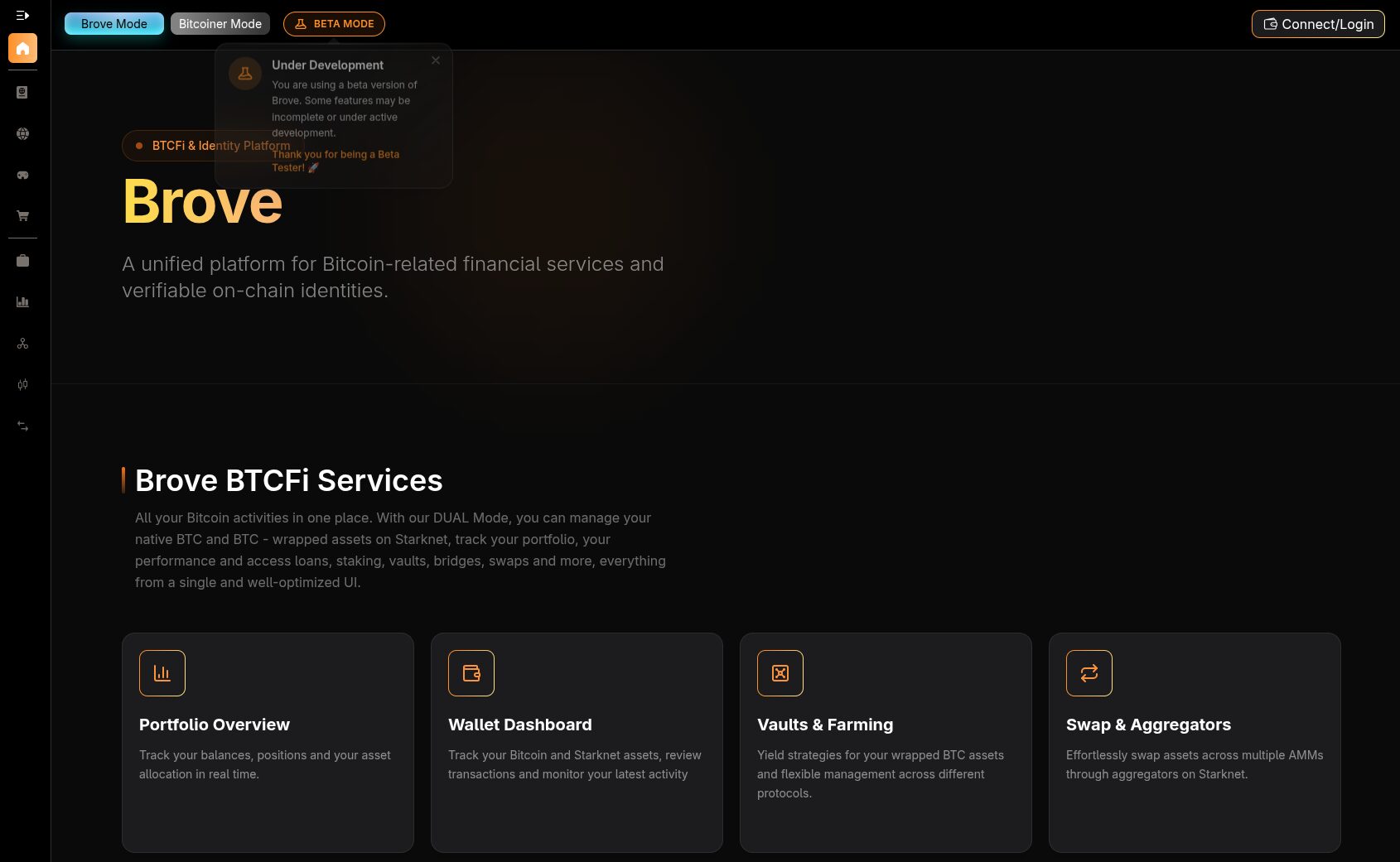
Its value proposition is to facilitate the discovery and execution of financial operations on Bitcoin simply and efficiently. By consolidating the BTCFi offering under a single user layer, tools such as Brove are catalyzing a silent revolution, demonstrating that Bitcoin's power does not have to conflict with a fluid and accessible user experience for everyone.