It is worth remembering how that rebound was built. It was not just FOMO. The escalation of US Treasury buybacks injected liquidity, leveraged shorts were blown out — nearly $3 billion liquidated — and open interest ended at half the October 2025 peak, with perpetual funding around 10% annualized, positive but far from euphoria. After all, that is a good sign: the move rested on spot demand rather than leverage.
Stablecoins enter the G20 financial agenda head-on
A market hangover
The hangover came quickly. On September 2 Bitcoin tested $77,000 and on September 3 it is around $77,600 after shedding 1.45% daily, according to FXStreet. It is moving in a narrow three-point range, between $76,500 and $79,500, just above its True Market Mean at $76,350, the average cost of all active investors. That level matters because breakeven sits there for some 880,000 coins: when it closed at $80,256 on August 27, 72.1% of supply was in profit; when it closed at $77,468 on September 2, only 67.7% was.
Technically, Bitcoin remains above its 50, 100 and 200-day moving averages, clustered between $69,200 and $72,400, with the daily RSI at 66 and the MACD losing momentum. The first serious cushion is the 200-day average at $72,367 and, lower down, $69,238 and $66,500. On the upside, the wall is $85,000. And in between, the zone everyone is watching: $76,000-78,000 as breakout support and $81,000-82,000 as resistance that separates a trend recovery from a bear market bounce, as 21Shares.
highlights. It is worth noting that September has been, since 2013, Bitcoin's worst month, averaging -2.86% with only five green Septembers. But the picture changes if you look at the detail: the red is concentrated between 2017 and 2021, when the asset was smaller and there were no ETFs. The last three Septembers — 2023 (+3.91%), 2024 (+7.29%) and 2025 (+5.16%) — closed green. Seasonality matters, but today the Fed matters more.
What is holding Bitcoin back and what is supporting it right now
The brake has a name and a date: Kevin Warsh, new FED chair since May 2026 after replacing Jerome Powell, and his Jackson Hole speech on August 28. There he focused on persistent inflation and opened the door to raising rates if it does not ease. The market took note. According to CME's FedWatch tool, the probability of a 25 basis point hike on September 15-16 went from 41-35% to 66-70% in a week, and the 10-year US Treasury yield rose to 4.78%, its highest level since January 2025, amid a global debt selloff.
Add oil to that. Tensions between the US and Iran have pushed WTI to $90.78 and Brent to $95, six-week highs, fueling fears that energy will reignite inflation. For a yieldless asset like Bitcoin, higher real rates and a strong dollar make the opportunity cost more expensive. As analyst Dean Chen explains to FXStreet, the current weakness looks more like a liquidity correction than a structural deterioration: "If the cost of capital eases and ETF flows stabilize, Bitcoin can recover, but until then liquidity rules."
And yet, there is a cushion. CryptoQuant's cycle momentum indicator has just turned positive for the first time in eight months, after a bear market that lasted from the October 2025 high of $126,000, a 39% drop to the June lows below $58,000. NUPL, which measures unrealized profit, is at 0.33 in optimism territory, without the capitulation readings of 2018 or 2022. Implied volatility, moreover, is cheap: 37.2, in the 18th percentile of the past year, below realized volatility of 41%. The market expects compression, not explosion, until the data speak.
ETFs: the best month of 2026 and a fragile start to September
If there is an institutional thermometer, it is ETFs. And here the August story is emphatic.
US spot Bitcoin ETFs took in $3.52 billion net in August, versus $172 million in July, according to SoSoValue and BingX. It is their best month since October 2025. Money came in on 16 of 21 sessions, with a nine-day streak between August 17 and 27. Peak days: $517 million on the 19th and $606 million on the 20th. Total assets jumped 31% to $99.61 billion, a step away from $100,000, and monthly volume grew 49% to $58.63 billion. Since assets grew more than price (+25%), it is not just appreciation: it is new capital.
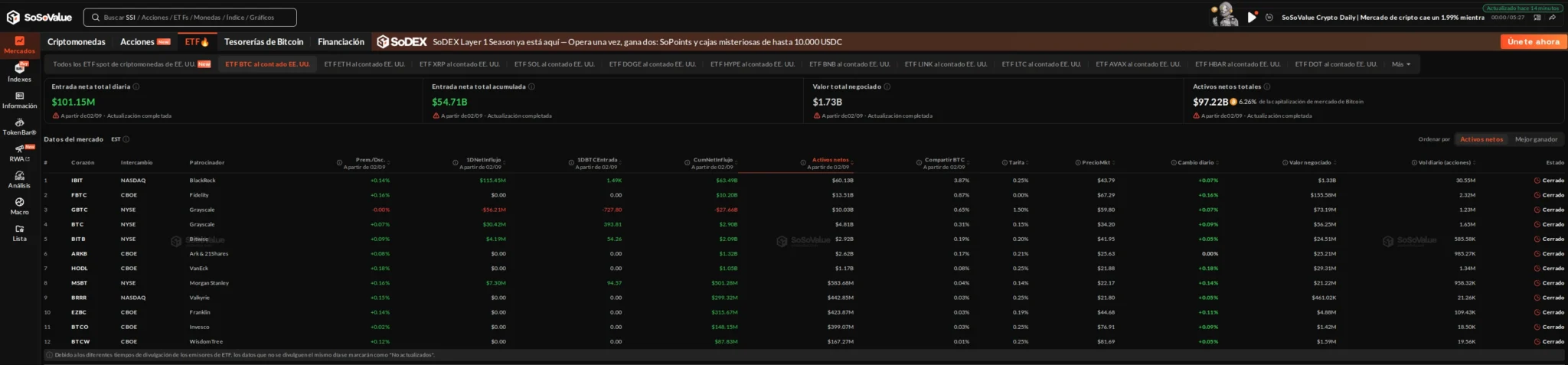
The data in context: at the end of July, ETFs had net outflows of $5.29 billion in 2026; at the end of August they had been cut to $1.77 billion. They are still in the red for the year, but they cut two-thirds of the hole in one month. The cumulative total since launch exceeds $54.6 billion and the funds custody more than one million bitcoins.
The September turn, however, cools the enthusiasm. On September 1, $236.46 million net flowed out, the largest redemption since July 31, led by BlackRock IBIT with $201.18 million, 85% of the total, and Fidelity FBTC with $43.67 million. Bitwise BITB, by contrast, added $8.38 million. On September 2, another $35.3 million in outflows were added, again with FBTC leading. On August 28 there had already been a warning with $201.8 million in outflows after nine days of inflows.
The rally fuels demand — will it hold?
The reading is not one of panic, but of rotation and profit-taking. As CoinCodexnotes, the rally rested on real spot demand, but in 7 of 12 months in which ETFs exceeded $3 billion in inflows, the price fell the following month. In addition, short-term holders have sent more than $500 million daily in BTC in profit to exchanges since the breakout, four times the prior pace and the highest level since December. If ETFs keep absorbing that paper, the floor holds; if they dry up, the pullback accelerates.
A structural change helps: BlackRock lowered the minimum for in-kind transactions from $25 million to $1 million and other issuers to $3 million. That allows large holders to exchange coins for ETF shares without selling and without immediate tax friction. It is plumbing, but it is the plumbing that turns a bounce into sustained flow. In fact, those operations already account for between 5% and 10% of volume in some funds, according to AInvest.
. Between the lines, Ethereum and XRP ETFs held up better on September 1-2, with inflows of $11 million and $14.4 million respectively, a sign that profit-taking was concentrated in Bitcoin after it led the rebound.
Santander, BBVA and 19 other major banks join forces to issue stablecoins
Companies: treasuries buying more than is mined
The other institutional pillar is not the funds, but the companies that put Bitcoin on the balance sheet as a reserve.
As of August 2026, some 200 listed companies hold more than 1.26 million BTC, more than 6% of the 21 million that will ever exist, valued at around $79 billion, according to Bitcoin.com and SatsIntel. The second quarter of 2026 was the largest quarter of corporate buying on record, with almost 110,000 BTC, and in the first half listed companies added 166,984 BTC net while miners produced some 81,153. In other words, companies absorbed more than double the new supply.
Two speeds in the market
The picture, however, is at two speeds.
Strategy (formerly MicroStrategy) remains the planet that drags the system along. As of August 10 it custodied 840,447 BTC (close to 4% of all supply) bought at an average cost of around $75,400, after acquiring some 175,000 BTC in 2026. But 2026 also shows the flip side. Some 6,900 coins were sold in five operations between late June and mid-August, below cost, to pay dividends on its preferreds and build a $4.8 billion dollar reserve. It even formalized a framework authorizing up to $5 billion in sales. Management insists it is temporary and that it remains a net buyer 25 times during the year.
The rest of the pack is opening up. Twenty One Capital, backed by Tether and SoftBank and listed via SPAC, already has 43,514 BTC; Metaplanet in Tokyo, the largest outside the US, went from 1,762 to 43,000 BTC since late 2024, although its target of 100,000 by the end of 2026 now looks distant and its buying pace has slowed with the price drop. MARA Holdings, a miner, retains 36,303 BTC despite having sold 15,133 in March. And in Latin America, Méliuz (Brazil) and MercadoLibre already hold positions, albeit modest ones.
A lesson for newcomers
The lesson of 2026 is harsh for newcomers. Bitcoin touched more than $126,000 in September 2025, closed the year at $88,000, fell to $68,000 in March and below $58,000 in late June. Those who bought high in 2025 are below cost, and several small treasuries (Genius Group, Sequans, Bitdeer) have liquidated everything and exited. The Bitcoin For Corporations study sums it up: high downside volatility correlates with shifting from buying to reducing exposure; the strategy is now *path-dependent* on the liability structure and liquidity.
Looking toward year-end, surveys by BitcoinTreasuries.net suggest that almost a third of investors expect listed companies to reach 1.7 million BTC and another 30% to 2.2 million or more. 69% expect gains in treasury stocks and 82% a recovery to the summer 2025 highs, though not necessarily in 2026. The risk they cite most is not internal but external: regulation, index exclusion (MSCI is consulting on removing non-operating companies) and prolonged market weakness. Japan, which is preparing to reclassify digital assets to cut the gains tax, could be a catalyst for more corporate adoption there.
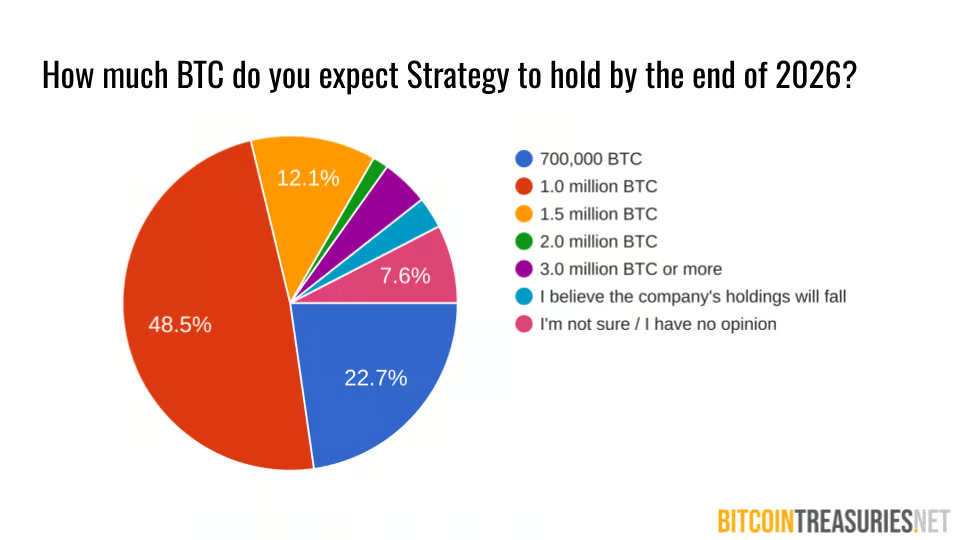
Between 2024 and 2026 the narrative has shifted: from speculative curiosity to structural necessity against inflation and devaluation, with a FASB that since 2023 allows marking to market and eliminates the accounting penalty. But 2026 reminds us that there is no free lunch: without cash flow or financing at a premium, the ecosystem's balance sheet creaks.
In Argentina, 94% of crypto trading in pesos is concentrated in stablecoins
What to watch until December 31?
Until year-end the market will not move on generic narratives, but on three dates and two levels.
The three dates that WhySoGeek and Bitfinex mark in red:
- September 4, 14:30 (Madrid), August nonfarm payrolls. Consensus 55,000 jobs after the -23,000 shock in July, with a range of -25,000 to 102,000. A very weak reading below 130,000 sharply cuts the probability of a hike and opens the door to a retest of $82,000-85,000. A strong reading with firm wages closes it and pressures $75,000.
- September 11, August CPI. This is the one Warsh watches. An upside core CPI would push hike bets toward certainty and would probably break $75,000.
- September 15-16, Fed and, just before, the Senate closure vote on the CLARITY Act (the 15th at 20:15 Madrid). Two catalysts in 24 hours: one macro and one crypto. The market now prices a 66% chance of a 25 bp hike; what matters is whether the Fed signals "one and done" or a sequence. Barclays expects two hikes in 2026; Goldman saw the September one as very unlikely in August. That dispersion says the market does not know, and that is why implied volatility for the September 11 expiry is the only one where puts and calls balance.
The two levels
- Support $76,000-78,000. This is the August breakout and the True Market Mean. Losing it with two daily closes opens the door to $73,500 and the short-term holder average cost at $69,980, then $68,500 and $65,000. Holding it, by contrast, keeps the breakout intact.
- Resistance $81,000-82,000. This is the 50-week average and the average cost of ETF holders. A weekly close above it separates a trend recovery from a bear market bounce and opens $85,000 and, after that, the annual high of $98,000. In between, realized volatility of 41% versus implied of 37% suggests options are cheap for what is coming.
Scenarios for year-end
- Hike ruled out (weak payrolls + soft CPI). Bitcoin retests $82,000-85,000 in September and, with Treasury buybacks and green ETF flows, heads into the fourth quarter with an option on $98,000. That is 21Shares' base case if support, a neutral FED and clean buybacks combine.
- One hike and stop. Sharp drop on the announcement and recovery within a week, range $72,000-80,000.
- Hawkish sequence. Loss of $72,000 and a search for $68,000; in that world August remains a bounce, although, and this is key, even that scenario would be read as the final retest of the bear market, not as the start of a new one: we are ten months from the October 2025 peak, in the historical window where Bitcoin has bottomed, with MVRV at lows and seller exhaustion.
For companies and ETFs, the implication is the same: demand exists — $3.05 billion in ETFs in August, 1.26 million BTC in treasuries — but it is sensitive to liquidity. If the Fed confirms that this is a rate-hiking cycle and Brent stays above $95 until CPI, the cost of capital will keep squeezing and flows will become selective. If, by contrast, payrolls cool the bets and Treasury buybacks contain the long end, the $76,000 cushion will hold and the market will have fuel to attack $81,000. That is where it is decided whether 2026 closes as the year of digestion or the year of the floor.
OECD warns: scams and fraud are the main risks for consumers in the AI era
The market rewards cash
The picture of Bitcoin at $77,600 on September 3 is not that of an asset adrift, but of one that has just shown it can rise 25% in a month when liquidity cooperates and that, at the same time, corrects 4% in three sessions when the Fed changes its tone. That duality is what companies and ETFs will arbitrage until December.
For treasuries, the bar has moved from "do I buy Bitcoin?" to "how do I finance it without volatility forcing me to sell?". Those with cash, a market premium and digital credit keep accumulating; those that leveraged up without cash flow are gone. For ETFs, the bar is even simpler: does money come in when the price is no longer a bargain? August said yes, with $3.52 billion 35% below the all-time high; September will say whether that conviction survives a CPI and a Fed.
If you are looking for a compass until year-end, forget the "September is bad" calendar. Look at the market's average cost at $76,350, daily ETF flows and the price of crude. If those three hold, the retest of $85,000 and the assault on $98,000 remain on the table. If they fail, what comes is not a new winter, but the last shakeout of this one.