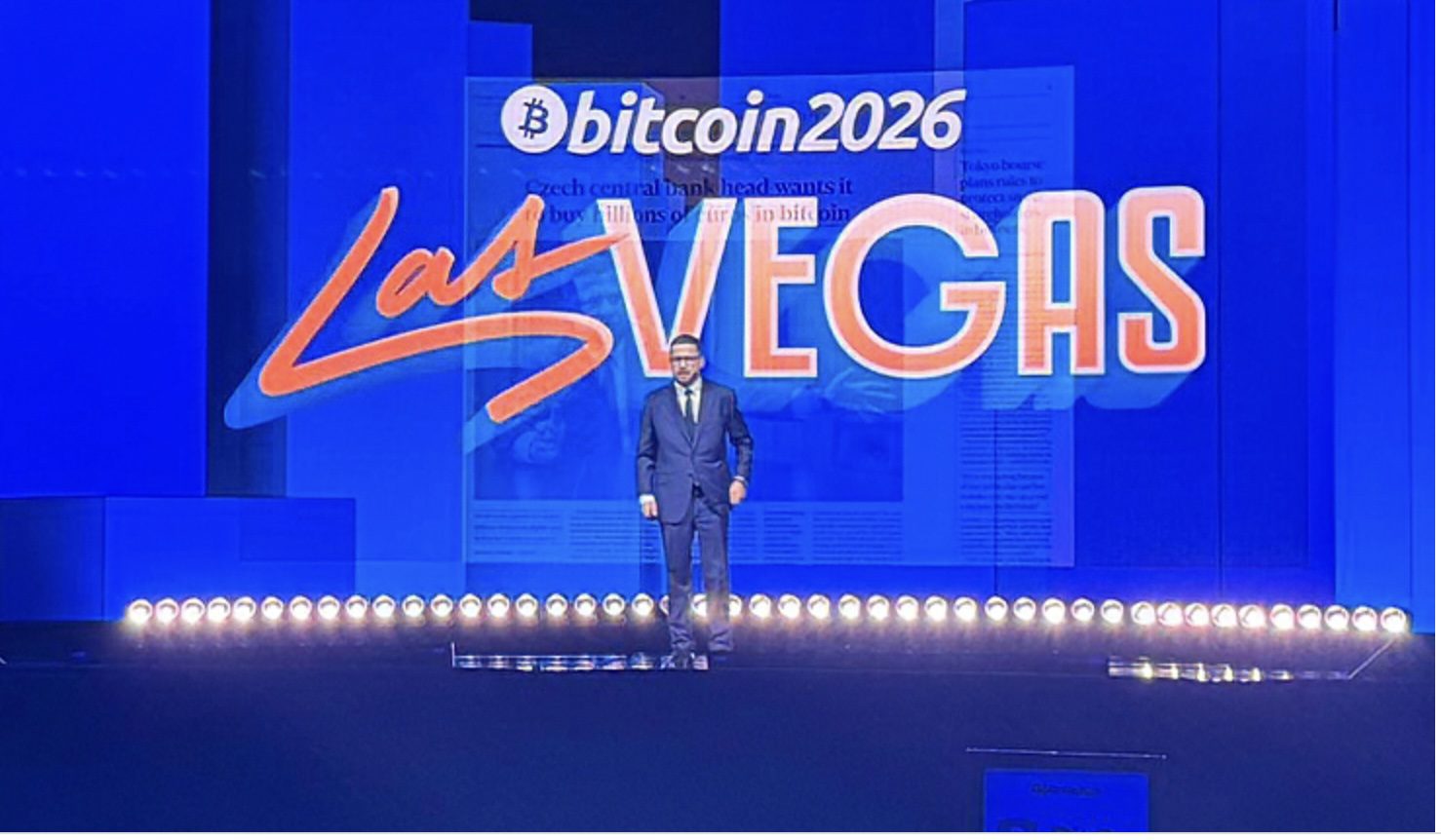
Good morning: today I want to talk to you about a strange combination: a central bank and Bitcoin. That is how his speech began the governor of the Czech National Bank (CNB), Aleš Michl, at the Bitcoin 2026 conference, in Las Vegas.
"Most people don't connect these two things. I do. In monetary policy, a central bank must be conservative. But it must also think ahead.When I took office as Governor of the Czech National Bank in mid-2022, inflation in my country was around 20 percent. 20 percent.

It was an important moment. When I took office, I said we would get inflation back to 2 percent within two years. And we did it. Not with magic. With discipline.

I said it clearly: even before COVID, money was too cheap for too long. For too long, the system encouraged borrowing. For too long, the currency weakened.
We changed that. We kept a tighter monetary policy for longer. We encouraged saving. And the koruna strengthened. For me, that is conservative monetary policy. Our rule is simple: keep a restrictive stance forever.
We also manage very large foreign exchange reserves. Very large. We manage around 180 billion dollars in reserves. That is roughly 44% of GDP. Relative to the size of our economy, our reserves are among the largest in the world.
Therefore, we must build the right investment portfolio for the future. Here you can see long-term risk and return. All in Czech korunas, the currency in which our books are kept. Bonds sit at the lower end. Low risk. Low return. Equities and gold can offer higher returns. But they also carry higher risk.
The next point is the Czech National Bank's portfolio. Over the past four years, we increased the share of equities from 15 to 26 percent. We also increased the share of gold from practically zero to 6 percent. We have created a diversified portfolio. A higher expected return than before. Lower risk than a portfolio made up exclusively of equities. And even lower risk than a portfolio made up exclusively of bonds.
But then the next question arose: Can we do more? Can we build an even stronger portfolio for the future? This is where Bitcoin comes in. The first time I used Bitcoin was about ten years ago, when I bought a coffee in Prague. Today, that coffee would cost about 350 dollars. It was the most expensive coffee of my life.
Bitcoin has delivered very high returns. But, frankly, it seems risky. It is much more volatile than other assets. One day, its price could be much higher. Or it could go to zero. Yes, zero. And this also applies to other assets. A stock can end up worth zero. Even a bond can fail. That is why it is not prudent to bet on a single asset.
We have to think about the entire investment portfolio. The next point on the chart is what we found in our new analysis. This is our model portfolio with 1 percent in Bitcoin. And here comes the interesting part. With 1% in Bitcoin, the expected return increases. And overall risk remains practically unchanged. That is what our new study shows.

Why? Because Bitcoin has a low long-term correlation with many traditional assets, it does not behave the same way. And that matters. By adding an asset of this kind, the portfolio as a whole can perform better. Return can increase and risk can remain practically unchanged.
That is diversification. Over the long term, Bitcoin can offer returns that are not closely tied to other assets. In a way, it resembles venture capital, but it is much more liquid.
So we started a separate test portfolio with Bitcoin. A test project portfolio. Not a revolution. Not a political statement. A test. We will run it for two years. Then we will publish the results. Then we will decide what comes next.
This is the future. Let us be conservative in monetary policy. Let us be innovative in the way we work"