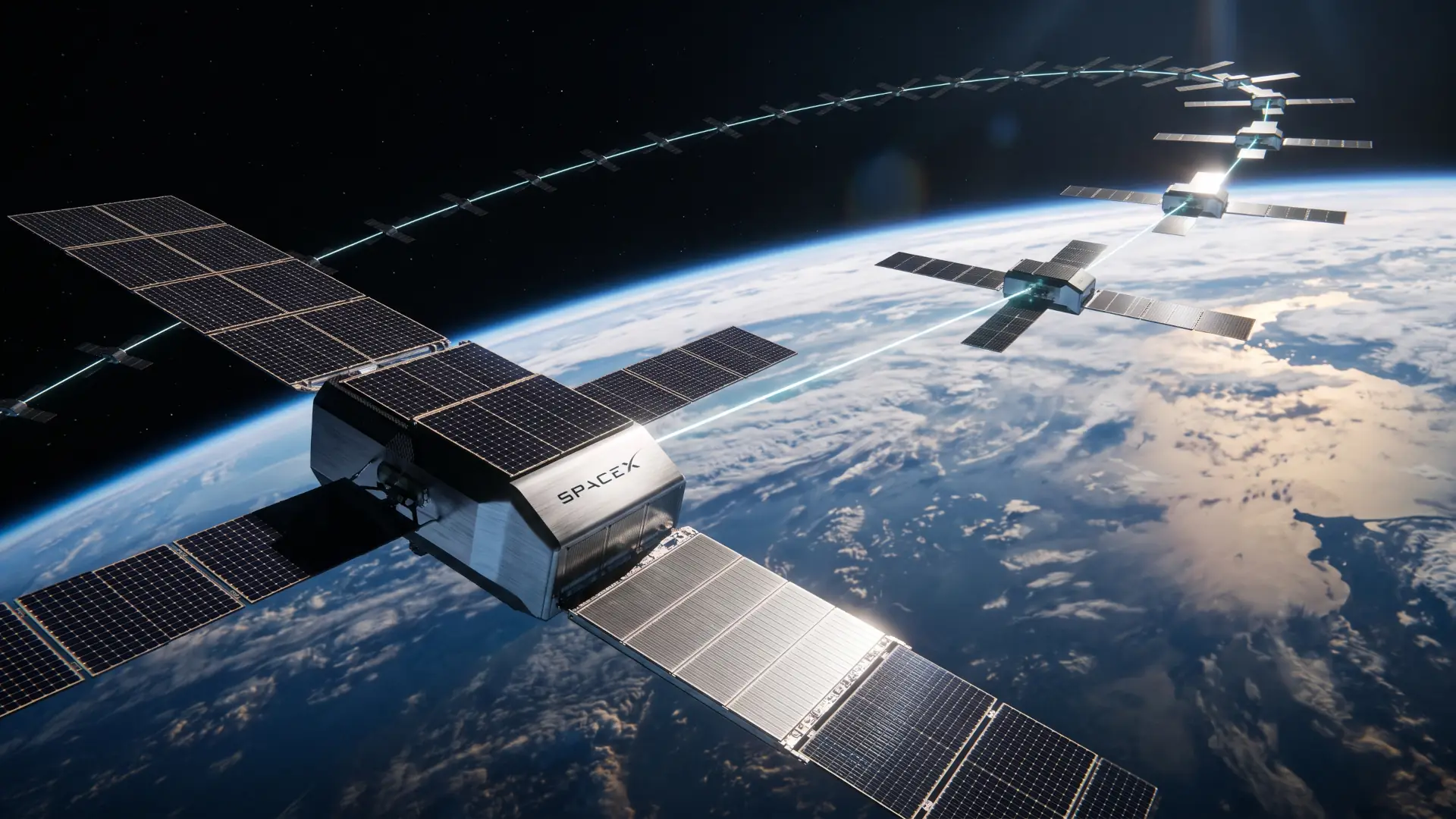
The United States Federal Communications Commission authorized SpaceX on November 25 to operate up to one million satellites intended for computing. The project is called Starmind and consists of bringing data centers into low orbit, powered by solar energy, to process artificial intelligence workloads and send the results to the ground.
The authorization is the first of its kind and comes at an awkward time for the industry: local communities in the United States have slowed the expansion of terrestrial data centers over water and electricity consumption. Orbit offers uninterrupted sun and avoids municipal pushback, in exchange for an engineering problem that no one has solved at scale.
The order of magnitude explains the uproar. One million satellites is a hundred times the current Starlink constellation, which stands at around 11,200 craft in orbit. Although the license does not require launching them all, the permit sets a regulatory framework for an infrastructure that would change the night sky and the computing market at once. The license sets a ceiling and a timetable, not a reality: the first craft will not arrive before 2027 and the thermal design remains unproven.
What the approval says
The document authorizes a constellation of up to one million satellites in orbits of 500 to 1,002 kilometers, spread across 50-kilometer layers and at inclinations of 30 degrees and sun-synchronous. Each craft would be 75 meters wide and 30 meters tall, according to the information published by the company.
The milestones are demanding. SpaceX must deploy at least one satellite before November 25, 2033, 10% before November 2035, half before 2038 and the full constellation before November 25, 2040. The company has said it wants to launch the first one in the third quarter of 2027.
The primary link would be optical, with Ka-band frequencies reserved for telemetry and control if the laser fails. The agency considered that this limited use addresses the objections of Viasat, Amazon Leo and the American Astronomical Society regarding interference, and rejected their petitions to deny.
Nvidia, ten terabits and an impossible radiator
The architecture looks more like a cluster than a communications satellite. Each craft would be around 250 kilowatts, the equivalent of a high-end computing rack, and would operate in close formation with ten others, linked by connections of about ten terabits per second. The company builds the craft with Nvidia.
The bottleneck is thermal. In a vacuum there is no air to evacuate, so heat only escapes through radiation, and a radiator for 250 kilowatts needs an enormous surface area. That detail, more than the launch, decides whether the cost per operation comes close to that of a terrestrial data center.
The race for computing and its physical limits had already put the focus on energy as a limiting factor. Starmind proposes to solve it with permanent sun and to forgo water cooling, a trade-off that still has no public demonstration at scale.
The rejections that accompany the license
The authorization dismissed the petitions from Amazon, Viasat and the astronomical society. Amazon had described the project as ambition without a plan and argued that it would take centuries to build. The agency responded that Musk's company is meeting its deployment milestones and that the others should look at their own.
The astronomical society was harsher in its public reaction: it declared itself dismayed by the impact on publicly funded research and criticized the lack of formal coordination requirements with the National Science Foundation. The agency replied that optical astronomy falls outside its remit.
There was also criticism over the timing. A lawyer for an environmental organization reproached that the decision was published during a holiday week and without environmental review, something the commission justified by saying it has no authority over those matters. The financing of data centers comes into play here: if capital becomes more expensive, the orbital project competes with cheaper terrestrial alternatives.
Orbital debris and graveyard orbit
The text leaves an important loose end. SpaceX asked to dispose of satellites located above 600 kilometers by sending them to heliocentric or graveyard orbits instead of burning them up in the atmosphere, and the agency deferred that request for lack of sufficient information to assess compliance with its rules.
Until there is an amendment, the craft will have to reenter. That obligation makes the design more expensive and limits service life, because a large satellite needs enough propulsion to come down. The alternative, leaving hardware in high orbit for decades, worsens the collision problem that already worries operators.
The project also admits that the density will require more evasive maneuvers. With one million objects, the tracking catalog and coordination protocols would have to work at a scale that does not exist today, and a coordination failure does not remain merely an economic loss.
What to watch from now on
The first indicator is the launch date. A first Starmind in 2027 would confirm that the timetable is real; a two-year delay would leave the license as an option without substance. The second is the cost per thermal watt, the metric that decides whether orbital computing can compete with solid ground.
The third is regulatory. The agency's decision rests on the fact that it has no jurisdiction over environmental and astronomical impact, and that interpretation is already being debated. Any future judicial review could reopen conditions that are now taken as settled.
The SpaceX satellite license sets the framework, not the outcome. One million satellites is a ceiling, and the question that remains is how many are needed for the project's economics to close before orbit becomes the next bottleneck.