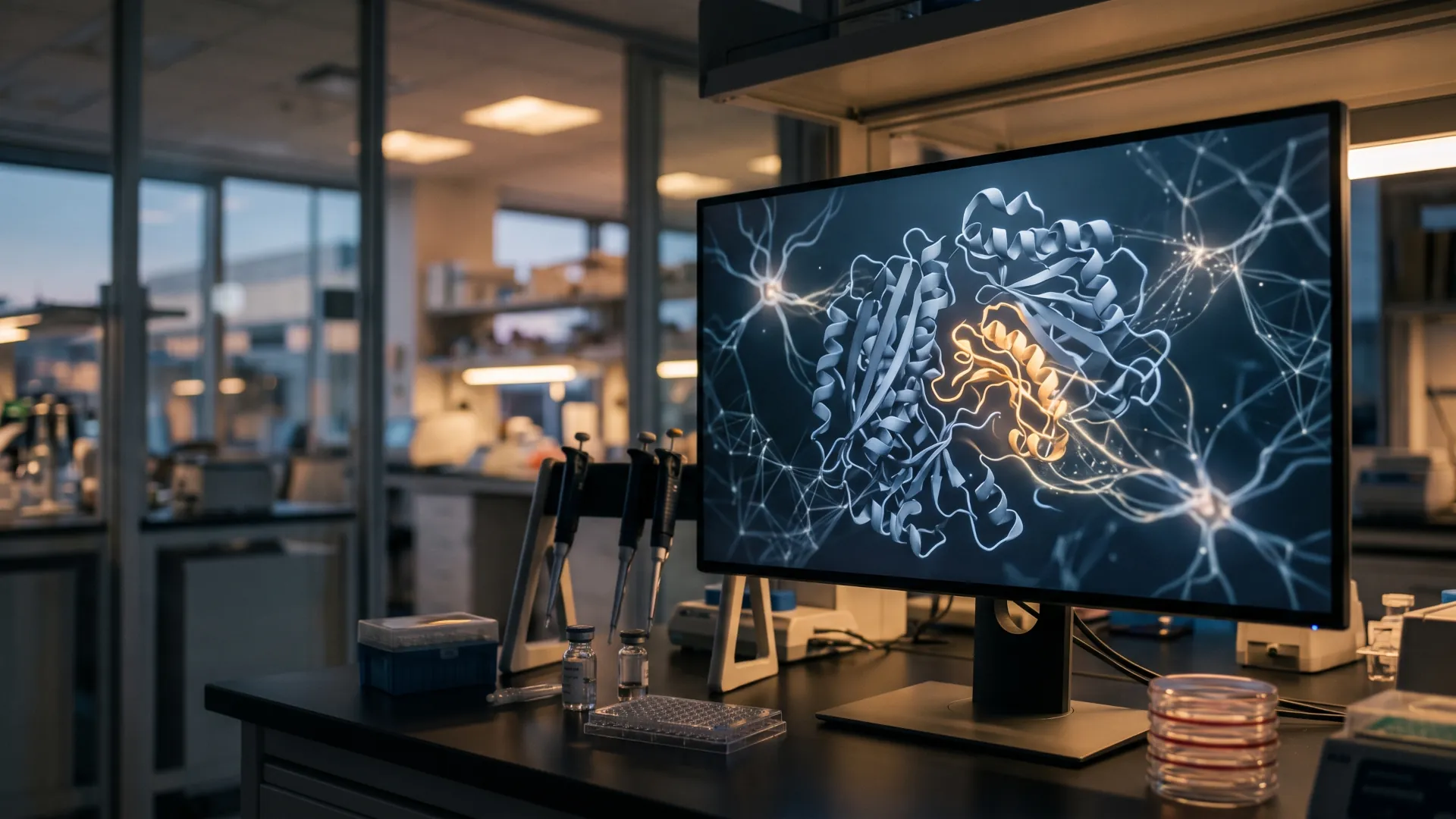
A family of language models has just proposed proteins that work in a laboratory. GPT-6's protein design relies on reasoning and code instead of dedicated biological tools. On November 24, OpenAI published a preprint in which its GPT-6 family designs protein structures and sequences using reasoning and code, without calling the specialized models that until now generated those designs. 322 minibinders were tested against five targets. Thirty-five showed evidence of binding, 10.9%.
The figure matters less than the method. The traditional workflow chains together tools with narrow tasks: one generates the protein backbone, another proposes the amino acid sequence that folds it, and a third predicts how it will turn out. A general model that does that work from instructions can absorb new constraints without retraining each tool, and that changes who can design.
It also changes what it means to publish a result. The work is a preprint, it has not been peer-reviewed, and OpenAI itself acknowledges that candidate filtering used specialized models. The promise is real and bounded: the model generated the structures and sequences, and other systems helped choose which ones deserved to be tested in the lab. That division of labor is the key to reading the result without exaggerating it in either direction.
The model's achievement
In the first experiment, a preliminary version of GPT-6.2 received the three-dimensional structure of five target proteins and the task of designing small binding proteins that would stick to specific sites. The model wrote and executed code to explore shapes and sequences, without a biological generator in the loop.
Then the usual selection chain came in. Tools such as SolubleMPNN proposed sequences and other models filtered candidates before they were manufactured. Lab partner Onava tested those minibinders against the five targets and found binding in 35. IL-17A added 18 and VEGF-A eight. PD-L1 contributed five, IL-7Rα three and TrkA one.
The second experiment reviewed new sequences (for minibinders and already known antibodies) instead of designing from scratch. The goal was to check whether the model understands the relationship between sequence and function, and not just the geometry of a new protein. Binding rates were 85% against MDM2 (75 of 88 designs) and 14% against PD-1 (8 of 59), with median divergences of 50% from the original sequence in VEGF-A.
Antibodies were also part of the test. Of 182 sequences redesigned in the binding loops, 128 retained binding to the original target, 70%. And of 272 fragments based on five therapeutic antibodies, 179 maintained binding to PD-1 or PD-L1, 66%.
The numbers behind the claim
The computational part of the preprint compares the model with specialized tools on tasks where those tools had been winning for years. In motif scaffolding, the in-house model reached a 43.7% success rate versus 27.8% for RFdiffusion. In blind docking of small molecules, it got the experimental pose right in 93% of the predictions evaluated versus 50% for DiffDock-L.
When told which two atoms form a covalent bond, it reached 92% versus 60% for the specialized model. In classifying mutation effects it beat ESM2-650M on average across four public datasets. And it accepted instructions on the number of helices or sheets in the protein with a fidelity that current tools do not allow without touching code.
That last point is what explains the enthusiasm of discovery teams. A designer can request constraints in natural language instead of translating them into the parameters of a pipeline. If the result holds up, the bottleneck stops being the tool and becomes the ability to formulate good biological questions.
The preprint covers 14 protein biology tasks, and that breadth is part of the argument. It is not just about generating a shape, but about predicting interactions, classifying mutations and building variants with specific constraints. Each task contributes a different piece to the same workflow, and the model solves them with the same reasoning and code mechanism.
The task that still fails
Predicting the complete structure of a protein from its sequence remains the territory of AlphaFold and its competitors. The mean TM score on the test set rose from 0.16 with GPT-5.6 to 0.38 with the most recent in-house model, while ESMFold2 averaged 0.93. The gap is too large to hide.
The preprint also acknowledges that some results may reflect memorization and that the specificity, stability and activity of the designed proteins have not been measured. Binding is the first step on a long road to a drug, and the study stops at that first step.
The comparison with RFdiffusion deserves context. The original work on that tool reported higher success rates, although the numbers depend on filtering and on how binding is defined. A 10.9% rate on a first attempt with a general model is notable. Presenting it as superior to a decade of specialized engineering would be another matter, and OpenAI itself avoids that conclusion in the text.
A new era for pharma?
The immediate value is not in replacing biological models, but in reducing the translation work between the idea and the experiment. A researcher who can describe the constraint in their own language and get workable candidates gains iterations, and iterations are what separates a discovery project from a paper. That saving does not eliminate the lab, but it changes how many times you can fail before you succeed.
The other consequence is about the market. If a general model covers tasks that previously required five tools, value shifts toward data and experimental validation, which are what no one can copy with a prompt.
The risk lies in premature trust. A model that succeeds at eye-catching tasks and fails at full structural prediction invites people to use its results without validating them, and in biology a poorly chosen candidate costs months of lab work. The race for frontier capabilities has already shown that a spectacular advance on one test does not imply a system that is useful for everything.
What comes next depends on independent replication. If other laboratories reproduce the binding rates with the same targets and the same filtering, protein design will have a new tool in the box. If not, it will remain a powerful demonstration of reasoning applied to a specific problem, which is also an interesting story and far less revolutionary.