Microsoft's AI doubles doctors' accuracy on complex diagnoses
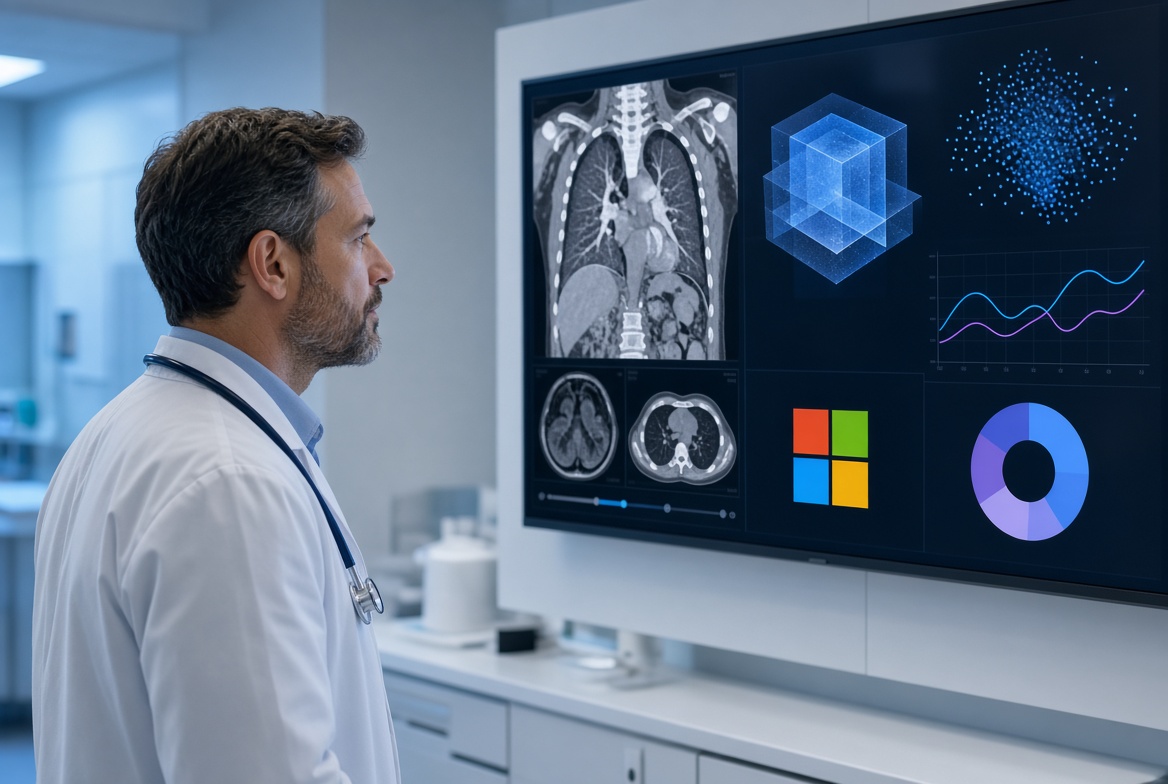
An AI system developed by Microsoft got 83% of diagnoses right in an evaluation of complex medical cases, compared with 36% of the participating general practitioners, who were able to consult books and the internet. The results, announced yesterday, 22 October, and published in Science, come from a test using documented cases. Evaluation with patients will be the next step.
The system, called Microsoft AI Diagnostic Orchestrator (MAI-DxO), works as a panel of virtual doctors: it proposes possible diseases, decides what information to request and revises its hypotheses as it receives new data. The evaluation included 304 complex cases published in The New England Journal of Medicine.
Asking questions and deciding on tests
The procedure reproduces part of the diagnostic process and, instead of receiving all the symptoms and results from the outset, participants start from a brief description and request information successively. The project documentation explains that an intermediary agent provides the history, examination findings and the results of the requested tests. Another agent compares the final diagnosis with the reference one. This evaluates both the answer and the path taken to reach it.
In the cases drawn from the MIMIC-IV-ED hospital database, the system reached 80% accuracy, compared with 47% for the doctors. Microsoft now announces a prospective study with Beth Israel Deaconess Medical Center, in Boston, to compare how the tool performs against independent assessments by professionals.
Emergency department data
The MIMIC documentation specifies that its selected cases come from patients admitted after going to the emergency department and do not represent all consultations in that service. The simulation uses text and does not capture all the uncertainty of talking to a patient, observing their progress or interpreting medical images directly. Nor does it measure treatment safety or health outcomes. The percentages therefore show diagnostic performance within that evaluation; their clinical usefulness will have to be verified in medical practice.
Covadonga Fernández is founder and director of the newspaper Observatorio Blockchain. She has worked with various companies developing crypto/blockchain projects, such as Singular DTV, a Switzerland-based platform and a pioneer in decentralizing the film industry, which led her to take part in the 2019 San Sebastián Film Festival. That same year she also took part in the Bern International Film Innovation Festival (Switzerland), with a presentation on linguistic plurality in blockchain. In 2022 she took part in the Acción Cultural Española edition with an article on Metaverse and Culture. In 2017 she wrote the chapter on Blockchain and Journalism in the book: «Blockchain: The Industrial Revolution of the Internet», published by Grupo Planeta. A year earlier, in 2016, she created the first Meetup on Blockchain and Journalism. That same year she also created the Blockchain Media site, to track the decentralization process of the cultural and creative industries. In 2020 she co-organized an event on how blockchain could help the cultural and creative industries, where the money received from sponsors was tokenized and speakers received payment in NFT format. Before founding Blockchain Media and Observatorio Blockchain, Covadonga worked at Grupo Z and the newspaper ABC; she was communications director of the Madrid Chamber of Commerce, a journalism professor at Universidad Carlos III de Madrid and chair of Telemadrid. Winner in the Outreach category at the 2024 Financial Innovation Awards and honored by Alastria at the 2025 Blockchain Awards