Fei-Fei Li unveils Atlas, an AI that generates, reconstructs and simulates 3D worlds
World Labs, the artificial intelligence company co-founded by Fei-Fei Li, unveiled on Tuesday, September 1, 2026, Atlas, an AI that generates images, video and navigable 3D worlds with an understanding of space and time. To achieve this, Atlas operates natively on text, images, video and 3D data within a single architecture, and allows everything from pixel-precise camera control to reconstructing real scenes and simulating robots, all from just a few input images. Fei-Fei Li is a Stanford professor known for creating ImageNet, one of the key projects in the development of modern deep learning.
The Atlas announcement comes after a year of expansion and heavy investment. In February 2026, World Labs raised $1 billion in a funding round backed by investors including NVIDIA, AMD, Autodesk and Fidelity, among others, to accelerate the development of its spatial intelligence technology. Last November 2025, World Labs launched Marble, its first commercial product, capable of generating explorable 3D environments from text, images or video; in January 2026 it introduced the World API and, on July 21, 2026, it acquired the robotics company SceniX. Atlas is the next step and, in fact, the company describes it as the foundation model that will power future versions of Marble.
World Labs defines Atlas as an omni world model, that is, a system that generates, reconstructs and simulates worlds in a general way. The company's thesis is "spatial intelligence," which basically holds that AI needs to reason about objects, places and consequences in three-dimensional space, not just process text. Atlas is the materialization of that idea in a single model, instead of dividing tasks among separate video, reconstruction and simulation systems, as is done today.
Technically, Atlas is an autoregressive multimodal diffusion transformer, pretrained from scratch. This means it combines three paradigms. It is multimodal, because it natively processes text, images, camera poses and 3D depth maps. It is autoregressive, because it generates each new element of a sequence conditioned on the previous ones, just like a language model. And it is diffusion-based (a rectified flow model), because it generates outputs by gradually removing noise, which allows it to trade off speed and quality depending on the denoising steps used (as happens with the well-known StableDiffusion).
Atlas's distinctive key is its "spatial context." Just as a language model encodes its input into a context, Atlas anchors each image to a specific position in 3D space. That shared spatial context is what allows the model to stay coherent in three dimensions, with everything it has seen, and to imagine what lies beyond. For example, the user can place two unrelated reference images, position them in space and Atlas generates a world that smoothly interpolates between the two, imagining doors, hallways and transitions.
The four main capabilities
Atlas covers four major areas of functionality. The first is camera-controlled generation. Starting from one or several reference images, it generates video of up to one minute at 1440p resolution (2k) with pixel-precise camera control. Unlike other models, which receive camera instructions as text, Atlas encodes them as native camera geometry, which allows each shot to be framed and each movement to be controlled accurately. The company compares the experience to being the director of a scene instead of pulling the lever on a slot machine and hoping the scene turns out as expected.
The second is spatial reconstruction. Atlas reconstructs real-world scenes from one or dozens of images, without the need for specialized capture equipment. It generates both frames from new viewpoints and explicit 3D outputs, such as point clouds and 3D Gaussian splats. The company claims that, with just two or three images, Atlas produces faithful reconstructions that outperform models specialized solely in 3D reconstruction, and that it can use more than one hundred input images to recreate complete real environments, such as the central courtyard of Stanford University shown in its demonstrations.
Spatiotemporal control
The third is spatiotemporal simulation. Atlas understands both the spatial structure of the world and its evolution over time. With recordings from as few as three to five cameras, it can freeze time and reframe shots from impossible angles, turning a few mobile phones into a "bullet time" capture studio. For robotics, Atlas reconstructs an environment from a video recorded with a phone and generates the RGB and depth data that a robot's sensors would observe as it navigates or manipulates objects, a workflow the company calls "Real-to-Sim."
The fourth is image generation: although it is not its main focus, Atlas follows complex prompts, renders text and produces a wide variety of visual styles, in addition to 360-degree panoramas.
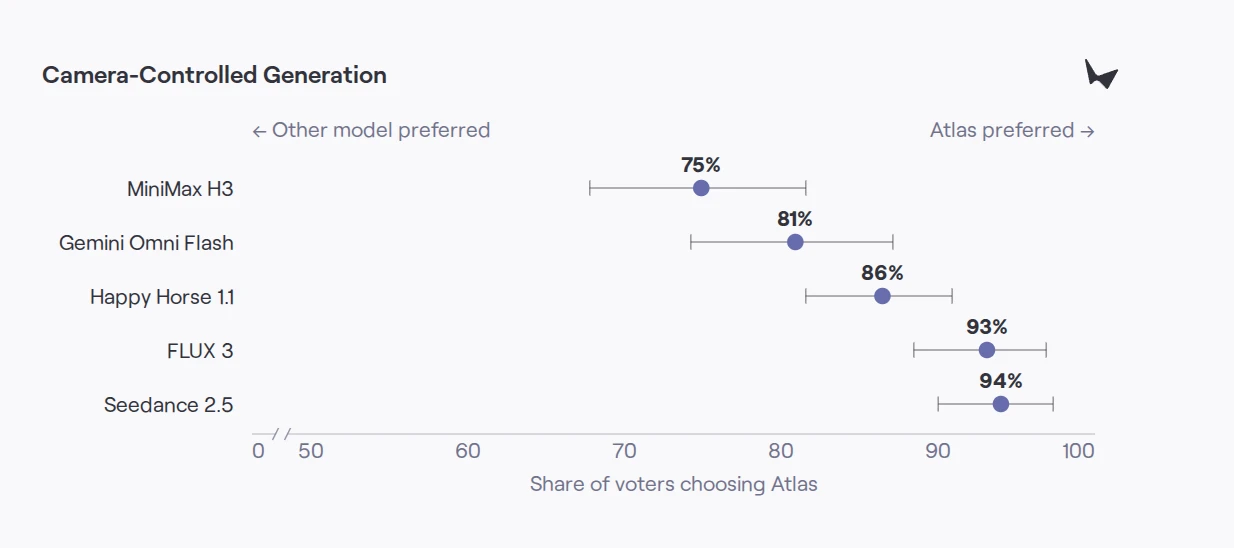
World Labs publishes comparisons on two key tasks. In camera-controlled generation, external human evaluators preferred Atlas over recent video models, with an advantage that grows the more complex the camera trajectory: 75% preference over MiniMax H3, 81% over Gemini Omni Flash, 86% over Happy Horse 1.1, 93% over FLUX 3 and 94% over Seedance 2.5. In 3D reconstruction from sparse views, Atlas outperforms five specialized reference models, including Pi3X, π³, VGGT-Ω, Depth Anything 3 and MapAnything, according to point map error on benchmarks such as DTU, ETH3D, KITTI, ScanNet and 7-Scenes.
An example of how users prefer to use Atlas over other models for camera-controlled scenes
It is worth noting that these figures come from World Labs itself, which is the one reproducing the competitors' results, and the company acknowledges that there is no single benchmark that captures the generality of an omni model. After all, the world models field is competitive. NVIDIA is working on its simulation stack Omniverse and its Cosmos models, Google DeepMind has shown its interactive renderer Genie 3, and startups such as Odyssey or Decart are developing interactive simulations, while Niantic Spatial focuses on geospatial mapping and Yann LeCun's lab, AMI Labs, on control models for the physical world. World Labs' bet is that a single model capable of accepting spatially anchored multimodal inputs and producing video, 3D geometry and simulated sensor views can sustain a category of its own.
A new future to explore
Atlas enters early access with selected partners; the company has not disclosed the number or identity of those partners, nor pricing or a general availability date. That means that, for now, independent validation of the model is pending its partners' workloads. The acid test, as the specialized press notes, will be whether Atlas maintains geometry when reference images contradict each other, whether it separates faithful reconstruction from plausible invention and whether its simulations remain useful once a robot begins to interact with the scene.
For World Labs, Atlas represents the consolidation of its thesis; an intelligence that understands space is the next step after language models. The company maintains that the model's performance improves with more training compute and expects that trend to hold as it scales. If the promise is fulfilled, Atlas could become the infrastructure for a new generation of creative and robotics tools, and the argument that spatial intelligence is, in addition to a promising scientific direction, a viable business.