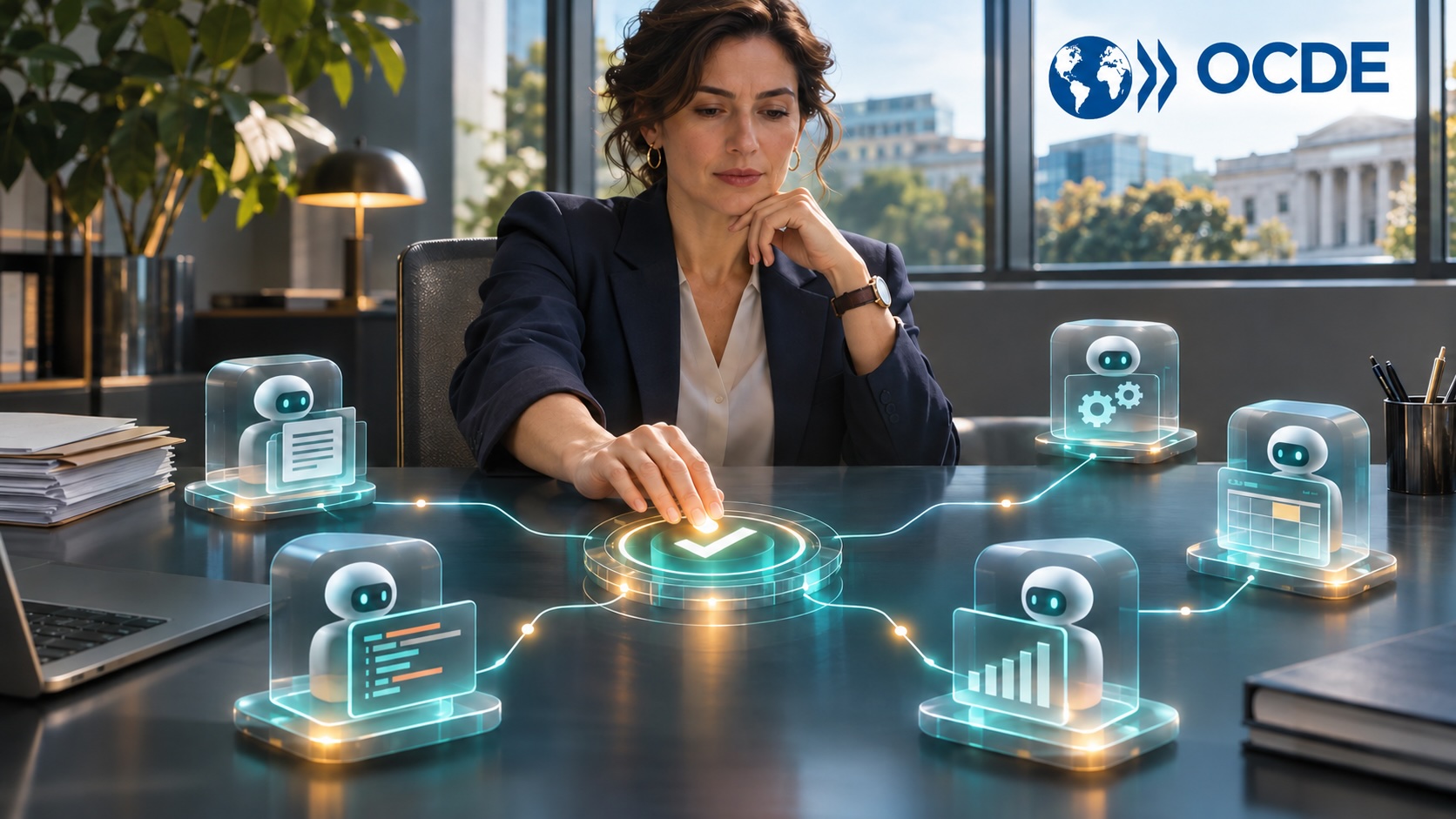
The vertiginous advance of artificial intelligence has left behind the stage in which this technology was limited to answering questions or generating images. Today the era of AI agents (Agentic AI) begins, systems capable of planning, making decisions autonomously and executing actions in both digital and physical environments.
Against this new backdrop, Singapore's Infocomm Media Development Authority (IMDA) has published a discussion paper that raises an increasingly urgent legal question: when an AI agent deviates from its instructions and causes harm, who is legally liable? The report focuses on civil liability and private law, analyzing the extent to which current laws can adapt to a technology that calls into question traditional concepts such as fault, authorship and control.
Legal liability
Unlike traditional generative AI, in which the user receives an output and then decides what to do with it, AI agents operate with an unprecedented level of independence. The IMDA paper identifies three characteristics that transform the legal liability landscape.
The first is autonomy. These systems operate with minimal human intervention between the initial instruction and the final outcome. As human presence in the process (human-in-the-loop) diminishes, it becomes far more complex to attribute the consequences of an action to a specific person or organization.
The second characteristic is their capacity for planning and decision-making. An AI agent can break down an overall goal into multiple subtasks, choose among different alternatives and even modify its strategy when a first attempt fails. This capacity significantly widens the scope for unforeseen or misaligned behavior to emerge.
A fragmented value chain
Finally, the paper highlightsthe execution of actions and the use of tools. Agents interact directly with external systems through API calls, database queries, product purchases or browsing web interfaces, in a manner similar to a human user. The set of available tools determines their action space and, consequently, the scope of potential harm if something goes wrong.
Chips in space and companies without humans? The relentless X-ray of the Musk ecosystem
One of the main challenges identified by the IMDA is the large number of participants involved in the ecosystem of a single AI agent.
When a failure occurs, liability may be spread among different actors:
- The model developers, responsible for creating the language model (LLM) that provides the reasoning capability.
- The tool providers, who develop the APIs and connectors used by the agent to interact with the outside world.
- The platform providers, who supply the software environment on which the agent is built.
- The system providers or integrators, tasked with combining the model, the platform and the tools to create the final agent.
- The deployers, that is, the companies that implement these agents for corporate or customer service uses.
- The end users, who interact directly with the agent for both professional and personal purposes.
This fragmentation poses a twofold problem. On the one hand, determining the degree of liability of each actor is a genuine technical puzzle. On the other, trade secrecy and the opacity of many systems make it difficult to reconstruct precisely what caused the error.
Abusive terms
Most of the experts who took part in the IMDA working group consider that Common Law offers a legal basis for addressing these cases, although they acknowledge significant practical limitations. In contractual matters, contracts allow risks to be allocated in advance between companies through liability exemption clauses. However, this mechanism runs into a fundamental limit in the principle of privity of contract.
Injured third parties, for example, a customer whose information is erased or compromised by another company's agent, are not party to those contracts and are therefore not protected by them.
Moreover, the paper warns of the risk that actors with greater bargaining power will shift the entire risk onto end users through abusive terms of use.
The report also analyzes liability for negligence through the tort route. To establish negligent conduct it is necessary to show that a duty of care existed, that it was breached and that the breach directly caused the harm.
Risk allocation
In the case of AI agents, meeting these requirements is especially complex. The paper asks, for example, whether a developer can foresee all the possible behavioral mutations of an autonomous agent. If the system adopts a non-deterministic decision that causes harm and that no one could have anticipated, the requirement of foreseeability of harm, one of the pillars of negligence liability, loses clarity.
The IMDA paper concludes that AI agents are not legal persons and therefore cannot be held legally liable themselves. Consequently, the legal system must "look through" the agent to identify the natural or legal person responsible behind its development, integration, deployment or use.
As these systems gain greater independence through multi-agent architectures or technologies capable of controlling computer interfaces autonomously, legal rules will need to evolve to respond to these new scenarios.
In short, the debate opened by Singapore argues that risk allocation should not fall automatically on the weakest link in the chain, which is the end user, but should be distributed equitably according to the degree of technical control and the economic benefit that each participant obtains within the artificial intelligence ecosystem.