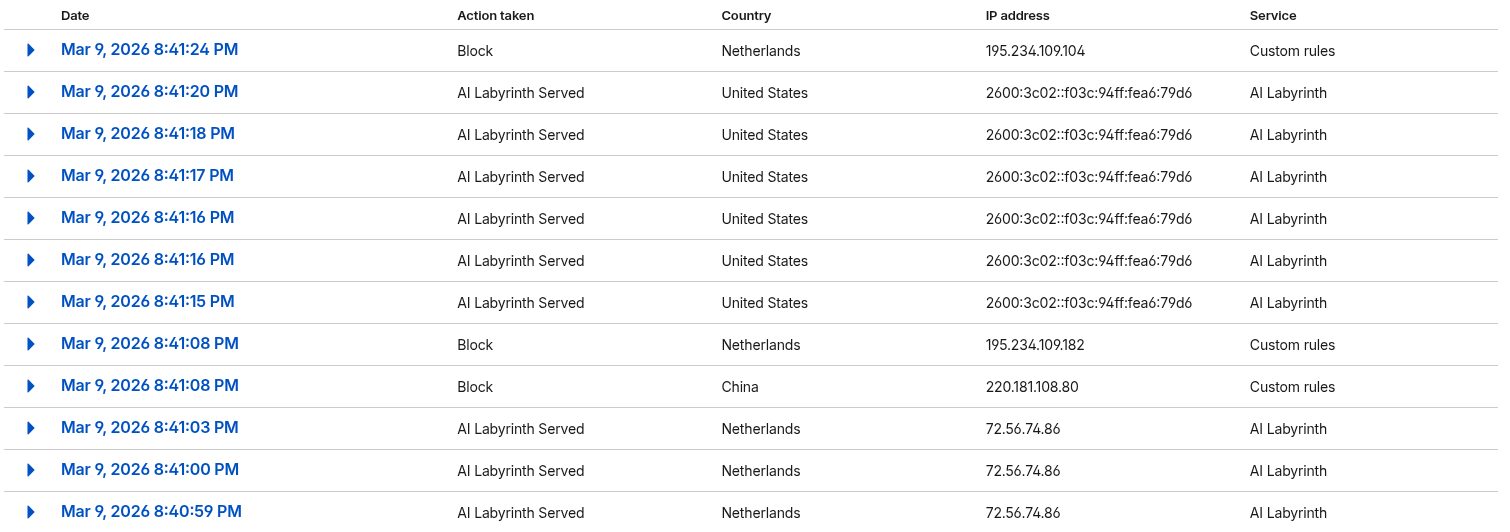
Observatorio Blockchain, a leading Spanish-language outlet on emerging technologies, received more than 10,000 visits from artificial intelligence bots in the last 24 hours, a figure that illustrates how AI systems are beginning to consume information directly from digital media.
This type of traffic normally comes from crawlers and agents used by language models to retrieve information, index content or feed automated response systems. Unlike human readers, these bots consult articles to generate answers on AI platforms, which is transforming the way journalistic content circulates on the internet.
AIs consume content, steal readers and do not pay
The phenomenon reinforces something Observatorio Blockchain has been denouncing for some time: AIs consume content, steal readers, but do not generate revenue for those who produce it. Today, when a bot consults an article to answer a user's question, independent outlets such as Observatorio Blockchain receive no financial compensation for that use of their content, unlike some large media groups that have reached agreements with artificial intelligence companies to license their archives and content.
Precisely to draw attention to this problem, Observatorio Blockchain promoted the creation of the International Day Against AI Scraping, an initiative aimed at raising awareness of the impact that the mass extraction of content by artificial intelligence systems is having on creators and digital media. The second edition of this day will take place on October 20, with the goal of promoting a global debate on the need to establish fair mechanisms for compensation for the use of content in the age of artificial intelligence.
Vitalik Buterin's proposal
This situation is precisely what Ethereum's creator, Vitalik Buterin, is trying to address. The developer proposes turning the blockchain into an economic layer for artificial intelligence, where machines can automatically pay for the resources they use.
In that model, when an AI system consults an article, a data point or a knowledge base, an automatic micropayment would be executed to the content creator. The transaction could be carried out through programmable payments on blockchain, without the need for intermediaries. The idea aims to create a digital economy in which AI systems pay for the data they consume, allowing journalists, researchers or creators to receive direct compensation when their work feeds artificial intelligence models.
How much money would it mean?
If a micropayment system were in place today, AI bot traffic could become a new source of revenue for media outlets. Taking as a reference the 10,000 bot queries recorded in 24 hours at Observatorio Blockchain, revenue would depend on the value of the micropayment per query.
In a scenario of micropayments for content use, bot traffic could become a source of revenue for media outlets. If each AI query generated a payment of 0.001 euros, the 10,000 daily queries recorded would amount to about 10 euros a day, equivalent to approximately 300 euros a month. If the micropayment were 0.005 euros, revenue would rise to 50 euros a day and close to 1,500 euros a month. In a higher scenario, with 0.01 euros per query, the outlet could earn 100 euros a day, which would amount to around 3,000 euros a month if traffic volume remained constant.
If bot traffic continued to grow, something many analysts consider inevitable with the expansion of AI agents, these figures could increase significantly.
The new internet of machines
The case of Observatorio Blockchain shows that the internet is no longer being read only by humans, but also by autonomous AI systems. In this context, the idea of creating a machine-to-machine economy, where agents pay to access information or digital services, is gaining interest among developers, researchers and technology companies.
For specialized media and content creators, this model could become a new revenue stream in an environment where artificial intelligence is changing the way information is produced, distributed and consumed.