During eleven nail-biting days in November, while shareholders hyperventilated, Colette Kress had to bear alone the weight of a multi-trillion-dollar empire. They handed her the keys on the 12th, after Jensen Huang's stampede out, and five days later they pushed her into the Wall Street slaughterhouse to prove that Nvidia was no mirage. Kress brought out the heavy artillery: $115.8 billion in revenue in a single quarter, an obscene record and 103% more than the previous year. At Nvidia that week, shareholders only asked what time the messiah in the leather jacket would land.
Return of the prodigal son
It was Kress herself who ended up signing the SEC form that made his stepping back official and certified the return of the prodigal son. She got the short straw of holding Nvidia together for twelve days, putting out fires with data and discretion; he got to capitalize on the epic once again and take center stage.
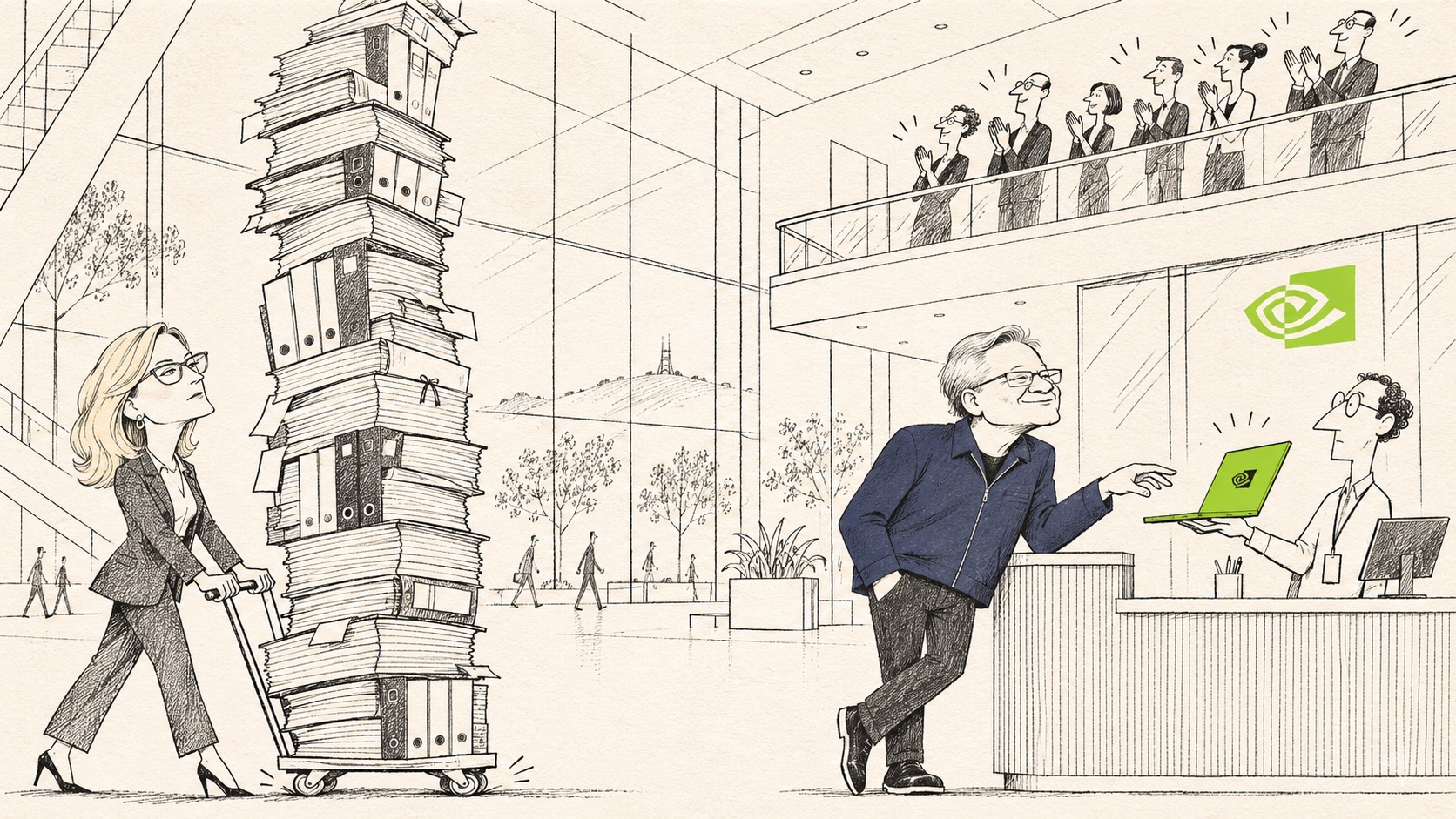
With the red carpet vacuumed, yesterday, Monday, November 23, Jensen walked through the glass doors of Endeavor, the headquarters in Santa Clara. He had left his iconic black jacket in the closet and replaced it with a navy blue cotton one. He had the harmless look of a grandfather who goes out to buy bread and comes back as an absolute emperor.
Who is Colette Kress, the finance chief who takes command of Nvidia after Huang's exit
The courtyard was madness. A crowd of employees with phones held high to capture the miracle in 4K. A handful of brave souls had signed a letter demanding his head, sorry, his return; the rest had devoted themselves to praying in silence, that noble form of labor struggle practiced by those with stock options still to vest. Huang put his hand to his chest, rehearsed his first-day-of-class face and said he had come with only the clothes on his back, without a computer, and would have to ask IT for one. DGX Spark!, a fanatic roared from above. RTX Spark!, Huang said without hesitation.
The DGX Spark is a desktop monolith with a GB10 Grace Blackwell chip and 128 GB of memory designed to crush AI models locally; a fearsome beast whose lid you cannot close no matter how hard you try. The RTX Spark is the brain Nvidia launched in October for laptops from Dell, HP, Lenovo and Microsoft. Huang demanded something light that he could snap shut and tuck under his arm if the board had another attack of dignity on Thursday. The marketing team, used to burning millions explaining the difference between two ranges, had just saved itself the campaign of the quarter.
Then came the liturgy of repentance. Huang apologized for the scare and swore to be a more sensible leader in his second life. The building trembled chanting his name. It would be touching to believe that roar was born of pure love, but in Palo Alto feelings are listed on the Nasdaq. When your net worth has been plunging off a cliff for eleven days, faith in the supreme leader springs up with supernatural force. California mortgage banks have the elegant habit of not asking which sewer the dollars came from.
The White House's partner
On Tuesday the 17th, Harvey Jones, chairman of the board, had ruled that Huang would never return. On Sunday the 22nd, that same board voted unanimously for his return. On Monday the 23rd, a statement announced that the directors were delighted with the founder's frankness. Between Tuesday's death sentence and Sunday's amnesty, a few calls from the upper echelons in Washington took place.
Donald Trump took exactly no time to claim authorship of the miracle. He had pulled the strings and Huang was an undisputed genius. Immediately afterward, Reuters dug through the archives and recalled that the president holds between $11 million and $55 million in Nvidia stock. The White House stepped in, swearing that the portfolio sleeps in a blind trust and that neither Trump nor his clan touches a key.
Yesterday, Monday, Nvidia closed up 31.5%, recovering almost a trillion dollars in one fell swoop. Meanwhile, under the rug, the MegaSpeed scandal keeps throbbing. Huang's ties to Alice Huang, a former executive at the Singapore firm, had set headlines ablaze. The espionage accusations remained unproven and Beijing played dumb. The board dispatched the matter by stating that, according to government reports, the boss's return did not jeopardize national security. In Congress, however, lawmakers from both sides are still demanding documents on the possible smuggling of chips to China. Wall Street needed just one session to acquit him with honors.
In his office, Huang drops the blue jacket onto the armchair and finally opens his laptop. The screen greets him with a festival of numbers in radioactive green, but the operating system cuts him off cold: his password has expired. He has been out of the fold for eleven days and the security server is the only employee at the company that doesn't get excited about the stock. They have given him back the chairmanship, the executive command and the board crown in a single batch, but to read his emails he has to wait like any ordinary mortal for a six-digit code to arrive on his phone.