OKXICE, the company of the cryptocurrency exchange OKX and Intercontinental Exchange (ICE), parent of the New York Stock Exchange, opened its market for tokenized US securities yesterday, Monday, November 23. Trading began at midday in New York, 18.00 in peninsular Spain, with six shares available to eligible clients in the United States. OKX has confirmed 113 securities for the phased rollout, including shares, exchange-traded funds (ETF) and other exchange-traded products (ETP).
The six shares at the launch were Coinbase, Securitize, Strategy, BitGo, Robinhood and Circle, all tradable against the USDC stablecoin. Fidelity Investments, eToro, Strive and Vida Global are among the additions to the announced catalogue. In its November 11 update, OKX planned to include 59 Direxion ETF, as well as Bettercom securities and Strategy's preferred shares. The Direxion funds alone account for more than half of the 113 instruments now announced.
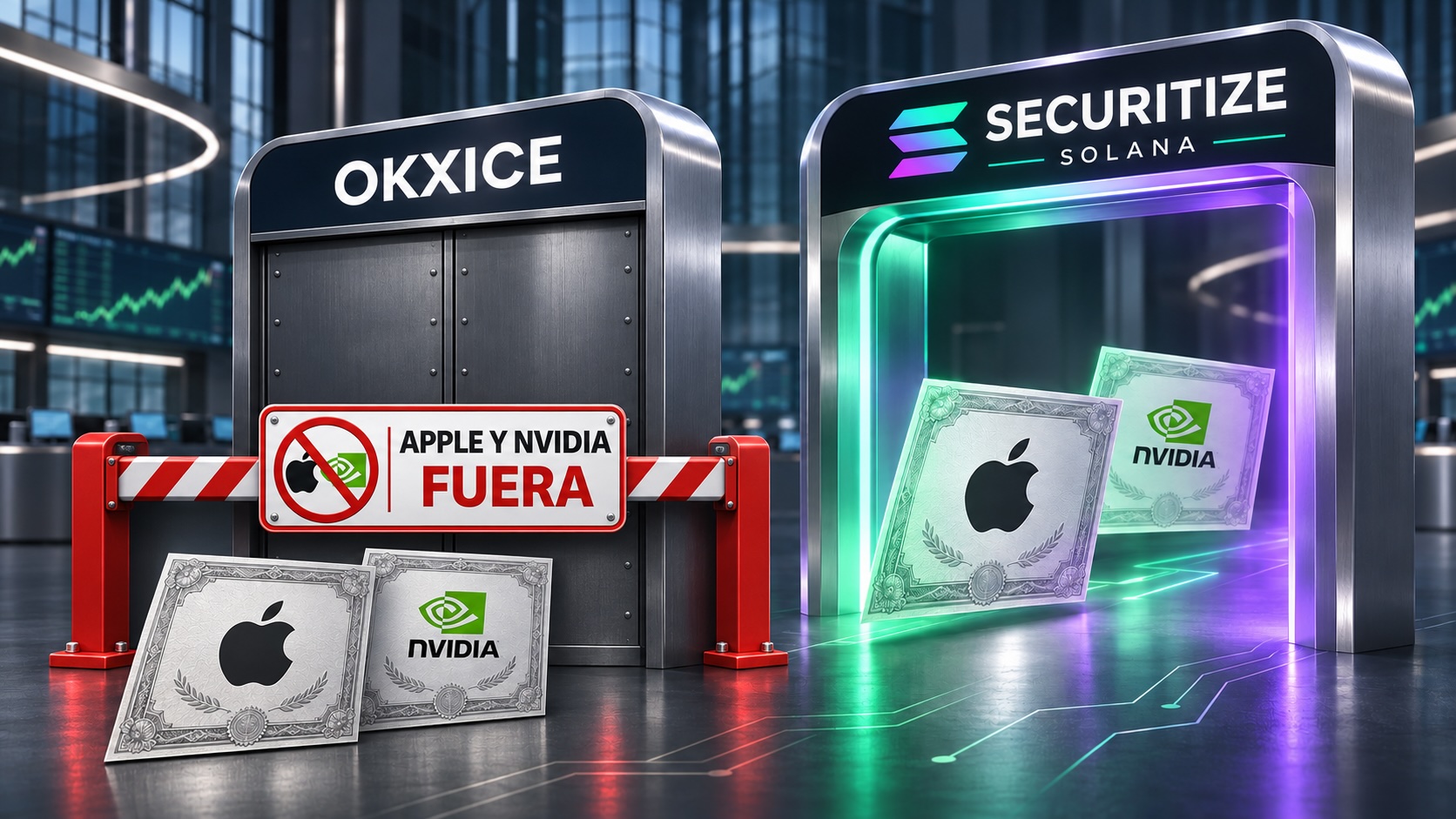
Why Apple and Nvidia are on Solana and were left out of OKXICE
Apple, Nvidia, Microsoft and Tesla opposed OKXICE offering tokenized versions of their shares. The objection took effect in that market, because Securitize already offered securities backed by shares of those same companies on Solana through its own broker. The difference lies in the rules under which each service operates.
OKXICE operates under a temporary SEC exemption. One of its conditions is that, if the platform wants to add shares tokenized by a third party other than the company that issued the securities, it must first notify that company. The listed company has 30 calendar days to object and if it does so within that period, OKXICE must exclude those tokens from its offering. That is how 56 of the 62 companies in the initial selection were left out. Another 11 companies that were not on that list also filed objections, bringing the total to 67.
Tokenized 24/7, the market OKXICE opens with 113 securities
Securitize plays two roles. On the one hand, it tokenized the six shares with which OKXICE opened. On the other, it has its own service, Securitize Stocks, which it launched on October 8 on Solana with 12 securities, including Apple, Nvidia, Microsoft and Tesla. In that service, trading is carried out through its registered broker and, according to Securitize, does not rely on the exemption used by OKXICE. The company planned to bring its offering to both markets, but the objections left those four listed companies out of OKXICE's launch.
OKXICE's notices list which companies objected, without explaining the reasons for each one. Nasdaq did state that if the same share is traded on several markets, comparing prices can become more difficult. OKX warns that, especially when the stock exchange is closed, the token's price may differ from the last price of the share backing it.
How tokenized shares are traded
Trades go through Uniswap v4 liquidity pools on X Layer, OKX's Ethereum layer-2 network. These pools allow buying and selling through an automated pricing mechanism. Smart contracts restrict trading and liquidity provision to authorized wallets. To gain access, eligible OKX clients in the United States must verify their identity and activate a self-custody wallet. Securitize provides the tokenization infrastructure.
According to OKXICE's documentation, each token represents a right over securities backed one-to-one by the underlying security. That right includes dividends and voting where applicable to the share class. The structure allows those rights to be exercised through the intermediary that holds the underlying securities. OKXICE operates under a temporary and conditional SEC exemption from the obligation to register as an exchange.