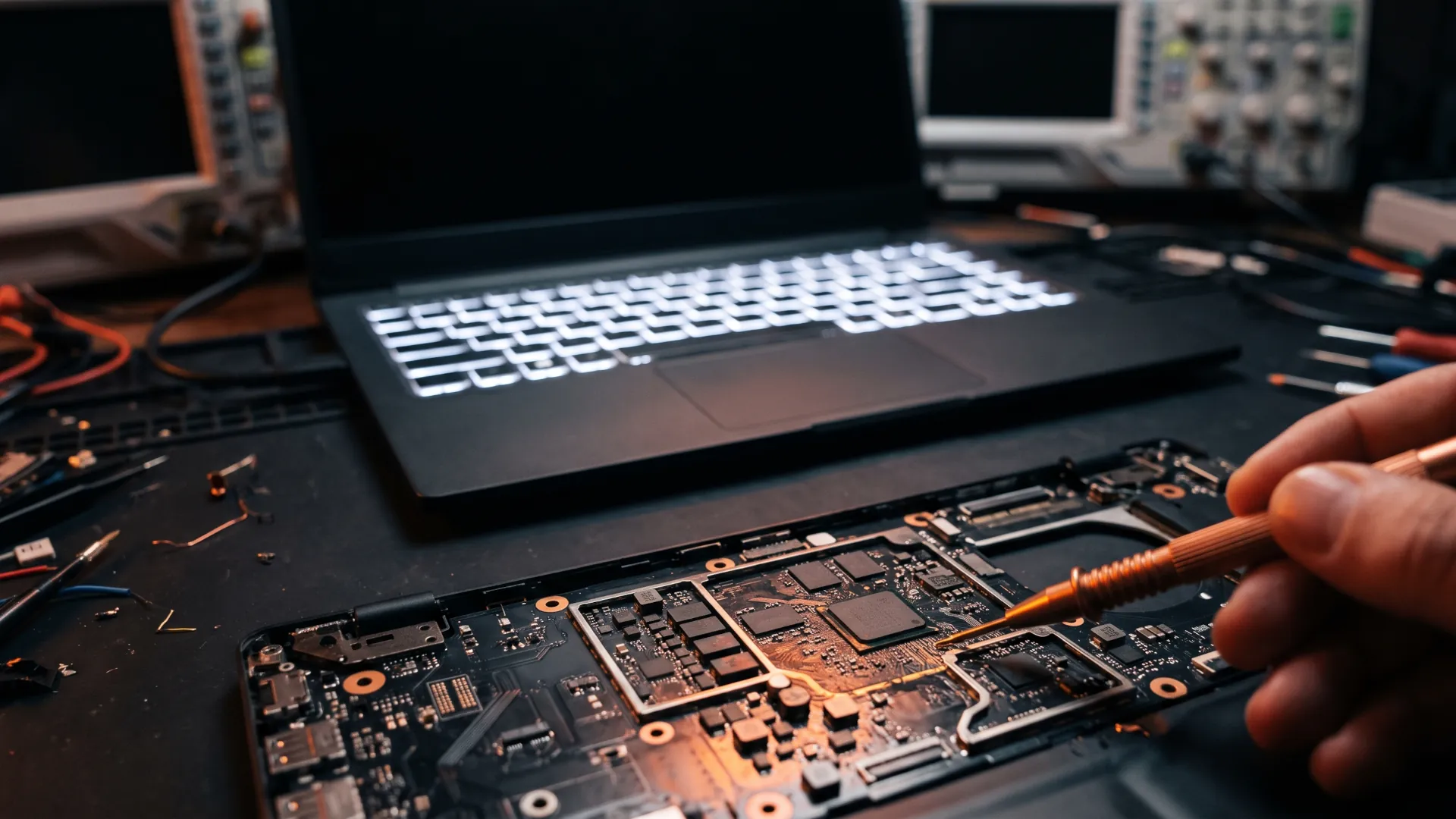
The first Linux kernel driver written in Rust to talk to a laptop's firmware now has a name and a destination. It is called clevo-laptop, it is signed by Nick Dowsett and its first version serves something as unglamorous as controlling the five-level white keyboard backlight on Clevo machines. Behind that modesty lies a shift in terrain: for the first time, a driver in the main tree uses the WMI abstractions written in Rust, and that piece had been waiting years for someone brave enough to debut it with their name on the mailing list.
The announcement came on November 22 with about 400 lines of code and an awkward dependency. The driver cannot yet be compiled against the stable kernel, because it needs two sets of abstractions that have not yet been merged: those for WMI and those for LED. That is, the first user of a kernel feature is also the one pushing for that feature to actually exist.
The choice of destination is no accident. Clevo sells its laptops under brands such as TUXEDO, XMG or Sager, which frequently preinstall Linux, so the driver has a real audience from day one even if all it does is turn on lights.
What is WMI and why does the language matter?
WMI is the interface Windows uses for programs to talk to the machine's firmware, and Linux implements it to be able to do the same on hardware designed with Windows in mind. Each laptop exposes its own functions there: brightness, power profile, battery status or keyboard color. The kernel driver translates those calls into something the operating system can use.
That boundary is one of the most delicate places in the kernel. The code that talks to the firmware receives data it does not control, with structures defined by a manufacturer that documents nothing, and it does so in the most privileged context of the system. A memory error there does not stay as a crashed application: it becomes an arbitrary write with kernel permissions.
Hence the interest in Rust. The language does not eliminate logic errors or wrong assumptions about what the firmware returns, but it does prevent an out-of-bounds access or a double-freed pointer from passing the compiler. On a surface that depends on foreign data, that guarantee changes the kind of failure that can occur.
The Clevo driver is, in that sense, a proof of concept with consequences. If the abstractions work for a simple case, the path is open for more complicated laptop drivers, which today are written in C and carry two decades of accumulated patches.
Four hundred lines and two dependencies
The scope of this first version is deliberately minimal. It controls the keyboard backlight in five steps and nothing more, because the stated goal is to exercise the WMI and LED abstractions before expanding functions. A driver that does little and compiles is more useful to the process than an ambitious one that never gets integrated.
The two pending dependencies set the schedule. The WMI abstractions in Rust allow a driver to be registered and receive firmware events without writing unsafe code, and the LED ones give the driver a standard way to expose the keyboard light to the rest of the system. Neither is merged, so the patch currently lives on the x86 platform drivers mailing list.
The Clevo tree is not the only one interested in that work. Laptops with backlit keyboards and their own power profiles are a large market, and each manufacturer arrives with its own WMI dialect. A Rust base that already handles registration and event handling saves each project the dangerous and repetitive part of the problem.
There is an irony in the detail of the 400 lines. The kernel has spent years arguing over whether Rust should enter the hardware subsystems, and the answer arrives through the back door: a small driver that works without rewriting anything that already exists.
Rust's long road in the kernel
Rust's arrival in the kernel has not been a door that opens, but a series of doors that open one at a time. First the minimal language support, then the character and network drivers, later the platform modules. Each step requires someone to write the necessary abstractions and someone else to agree to maintain them for years.
The first WMI driver in Rust sits in that sequence and adds a new category: code that talks directly to ACPI and to the machine's firmware. It is the terrain where C has the biggest advantage, and also where a memory error costs the most, which explains the caution with which the project has moved.
The example of the driver AMD sent to the kernel for its AI Engine shows the other end of the spectrum. There the work weighs by volume and hardware complexity, and the language is a secondary decision next to the quality of support. Here volume is irrelevant and the language is everything.
What remains to be seen is whether the pattern repeats. A Clevo driver solves a lighting problem, but it opens the door for the next manufacturer with a complicated keyboard to write its driver in Rust instead of copying a fifteen-year-old C template.
What this announcement does not solve
Expectations should be tempered. A 400-line driver for a backlight does not change the hardware support of any laptop that today has problems with the battery, the fingerprint reader or fan control. Those functions remain in C, still depend on reverse engineering and will keep breaking with every firmware generation.
Nor is there a date. The patch is on the mailing list, not in a branch that will enter the next merge window, and the two dependencies it needs have their own reviewers and their own deadlines. Anyone installing a development kernel hoping to see the change will find it is not there yet.
The value of the announcement is different and has to do with the direction of the project. Every abstraction that gets merged lowers the cost of writing the next driver and raises the probability that someone will do it in Rust instead of C. The work already emerging in kernel 7.5 confirms that the pace is not slowing, and this piece fits into the least visible part of that schedule.
For the average user, the practical consequence will arrive late and without notice: a laptop that today needs a third-party module to turn on the keyboard will work out of the box in a year or two, and no one will write a note about it. That is the normal fate of infrastructure that works.